
Quick Answer
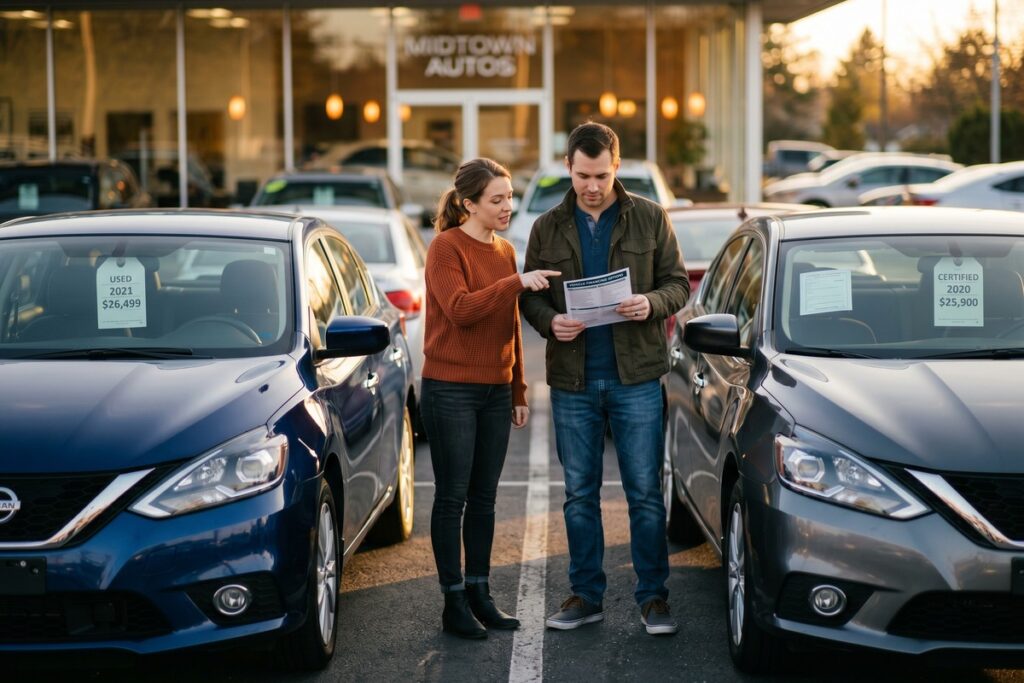
In July 2025, a standard used car loan typically carries rates of 11–14%, while CPO financing from manufacturers averages 4–7% — but CPO vehicles cost 10–20% more upfront. The better deal depends on your credit score, how long you hold the vehicle, and whether manufacturer incentives are active.
The used car loan vs CPO debate comes down to a single question: does the lower interest rate on a certified pre-owned vehicle justify its premium price tag? According to Experian’s State of the Automotive Finance Market, the average used car loan rate in Q1 2025 was 12.01%, while manufacturer-sponsored CPO rates regularly sat between 3.9% and 6.9% for qualified buyers. That gap is substantial — but so is the sticker difference.
With vehicle inventories stabilizing after years of post-pandemic volatility, buyers now have real negotiating leverage on both sides of this comparison. Choosing wrong can cost thousands over a 60-month loan term.
How Do the Interest Rates Actually Compare?
CPO financing almost always carries a lower stated APR than a standard used car loan — sometimes by 5 to 8 percentage points. That difference is real, but it comes with strings attached.
Manufacturer-backed CPO programs, such as those offered by Toyota Financial Services, BMW Financial Services, and Honda Financial Services, subsidize rates to move inventory. These are captive lender programs, meaning the automaker controls the financing directly. Rates as low as 3.9% APR are common during promotional periods, according to Consumer Reports’ CPO analysis. Standard used car loans, by contrast, are issued by banks, credit unions, or online lenders and priced against your credit profile.
Credit Score Impact on Both Loan Types
For a standard used car loan, your FICO Score is the primary rate driver. Borrowers in the “deep subprime” tier (below 580) can face rates exceeding 20%, per Experian data. CPO programs typically require a minimum score of 680–720, effectively excluding buyers with damaged credit. If your score falls below that threshold, a standard used car loan from a credit union may be your only realistic option. Before applying for either, it helps to understand the difference between auto loan pre-approval and pre-qualification so you know what lenders will actually see.
Key Takeaway: CPO financing rates average 4–7% APR versus 11–14% for standard used car loans, but CPO programs typically require a credit score above 680. See Experian’s automotive finance data for the latest rate tiers by credit band.
What Does CPO Certification Actually Cost You?
The CPO premium is real and quantifiable. Certified pre-owned vehicles typically carry a price markup of $1,500 to $3,500 over comparable non-certified used vehicles, according to Kelley Blue Book’s CPO pricing research. That markup buys you a multi-point inspection (usually 150–200 points), an extended warranty, and roadside assistance.
The calculus changes based on the vehicle’s age and mileage. A 2-year-old vehicle with 22,000 miles under a CPO warranty has significant remaining value in that certification. A 4-year-old vehicle near the end of its CPO eligibility window — most programs cap vehicles at 6 years old or 80,000 miles — offers far less warranty coverage for the same premium.
Hidden Costs in Standard Used Car Loans
Standard used vehicles carry their own cost risks. Without a CPO warranty, a single major repair — a transmission failure, for instance — can cost $3,000–$5,000 out of pocket. Buyers often underestimate this exposure. If you’re financing a non-CPO used car and considering whether to pay it down faster or invest the difference, the analysis in this breakdown of paying off an auto loan early vs. investing is directly relevant to your total cost of ownership math.
| Factor | Standard Used Car Loan | CPO Financing |
|---|---|---|
| Typical APR Range | 11%–14% (avg. credit) | 3.9%–6.9% (promotional) |
| Vehicle Price Premium | No premium | $1,500–$3,500 above market |
| Warranty Included | None (as-is) | Extended warranty (varies by brand) |
| Credit Score Minimum | No hard minimum | Typically 680–720 |
| Vehicle Age Limit | No limit (lender varies) | Usually 6 years / 80,000 miles |
| Negotiability | High (private sale or dealer) | Low (manufacturer controls pricing) |
| Inspection Required | None mandatory | 150–200 point inspection |
Key Takeaway: CPO vehicles carry a typical markup of $1,500–$3,500 over non-certified equivalents, per Kelley Blue Book. That premium is only worth paying if the vehicle is young enough that the extended warranty provides meaningful remaining coverage.
Which Option Saves More Over a Full Loan Term?
On a pure interest-cost basis, CPO financing wins — but the vehicle’s higher purchase price often erases that advantage. Run the numbers on a concrete example to see why.
Assume a comparable vehicle is priced at $22,000 as a standard used car and $24,500 as a CPO unit — a realistic $2,500 premium. Financed over 60 months at 12% (standard used) versus 5.9% (CPO), the used car costs approximately $7,836 in total interest, while the CPO loan costs approximately $3,856 in interest. That’s a $3,980 interest saving on CPO. But the $2,500 price premium reduces the net advantage to roughly $1,480 — before factoring in the warranty value.
The math flips if you have excellent credit. A borrower with a 780+ FICO Score can qualify for used car loan rates as low as 6–8% from a credit union, narrowing the CPO rate advantage dramatically. The comparison of new vs. used car loan costs provides additional context on how rate tiers interact with total vehicle cost.
“Consumers fixate on the monthly payment instead of the total cost of the loan. A CPO vehicle with a low manufacturer rate can look cheaper per month but cost more overall once you account for the higher selling price and reduced negotiating room.”
Key Takeaway: On a $22,000 vs. $24,500 vehicle comparison, CPO financing at 5.9% saves roughly $1,480 net over a 60-month term versus a standard used loan at 12% — but that advantage shrinks significantly for borrowers with scores above 750.
What Are the Biggest Risks of Each Option?
Each financing path carries distinct risks that go beyond the interest rate. Knowing them in advance prevents costly surprises.
The primary risk with a standard used car loan is the vehicle itself. Non-CPO vehicles are sold without mandatory inspection standards. A private seller is not required to disclose mechanical issues in most states. Running a CARFAX or AutoCheck report — and paying for an independent pre-purchase inspection from a licensed mechanic — is non-negotiable. The Federal Trade Commission (FTC) advises all used car buyers to obtain a vehicle history report before signing any purchase agreement, per its official used car buying guidance.
The risks with CPO financing are subtler. Many buyers don’t read the warranty terms carefully. CPO warranties from different manufacturers vary enormously in what they cover. Some dealers also add a dealer-backed “certified” label that is not the same as the manufacturer’s official CPO program — it carries far weaker protections. Always verify the certification is manufacturer-issued, not dealer-issued. Common financing mistakes at the dealership — including accepting add-on products without scrutiny — are detailed in this guide to car financing mistakes to avoid at the dealership.
Key Takeaway: The FTC recommends all used car buyers obtain a vehicle history report before purchase. For CPO vehicles, always confirm the warranty is manufacturer-issued — dealer-certified programs offer significantly weaker protections than official programs from automakers like those described in FTC guidance.
Who Should Choose a Standard Used Car Loan vs. CPO?
The right choice depends on your credit profile, budget flexibility, and risk tolerance — not a universal rule.
A standard used car loan makes more sense if you have strong credit (720+) and can qualify for competitive rates from a credit union, if the CPO premium exceeds $2,000 for a vehicle over 4 years old, or if you’re buying from a private seller where CPO financing isn’t available. Buyers with limited credit history should review how to get a first auto loan with no credit history before approaching any dealership.
CPO financing makes more sense if your credit score falls in the 680–740 range where standard used loan rates spike above 10%, if the vehicle is less than 3 years old with significant warranty coverage remaining, or if a manufacturer is running a promotional rate campaign (common in Q4 and during model-year transitions). Always check whether the APR offer applies to your loan term length — many promotional CPO rates are only available for 36- or 48-month terms, not 60 or 72 months.
Key Takeaway: Buyers with credit scores above 720 often save more with a standard used car loan from a credit union than with CPO financing, while borrowers in the 680–720 range benefit most from manufacturer CPO rates. Loan term length is critical — many CPO promotional rates expire at 48 months.
Frequently Asked Questions
Is CPO financing always cheaper than a regular used car loan?
No. CPO financing typically offers a lower APR, but the vehicle’s higher purchase price can offset the interest savings. On a 60-month loan, the net advantage of CPO financing may be less than $2,000 after accounting for the price premium, and it can disappear entirely for buyers with strong credit who qualify for competitive used car loan rates.
What credit score do I need for CPO financing?
Most manufacturer CPO programs require a minimum credit score of 680–720. Some premium brands like BMW and Mercedes-Benz may require 720 or higher for their lowest advertised rates. Buyers below these thresholds are typically redirected to standard used car financing through third-party lenders.
Can I negotiate the price of a CPO vehicle?
Yes, but CPO vehicles have less negotiating room than non-certified used cars. Dealers have already invested in the inspection and certification process, which they use to justify the premium. You can often negotiate on add-ons, warranty extensions, or dealer fees, but the base price typically moves less than on a comparable non-CPO unit.
Does a CPO warranty cover everything on the vehicle?
No. CPO warranties cover powertrain and often many mechanical systems, but exclusions vary significantly by manufacturer. Wear items like tires, brakes, and wiper blades are almost never covered. Always read the warranty contract — not just the marketing summary — before signing.
What is the used car loan vs CPO break-even point?
The break-even depends on the rate spread, the price premium, and the loan term. As a general rule, CPO financing breaks even against a standard used car loan when the rate difference is at least 4 percentage points and the vehicle price premium is below $2,000. If either condition isn’t met, run your own numbers using an auto loan calculator.
Can I get CPO financing from my own bank instead of the manufacturer?
Yes, but you won’t receive the manufacturer’s subsidized rate. If you use Chase Auto, Bank of America, or your local credit union to finance a CPO vehicle, you’ll receive standard used car loan rates based on your credit. The low CPO rate is only available through the manufacturer’s captive finance arm, such as Toyota Financial Services or Honda Financial Services.
Sources
- Experian — State of the Automotive Finance Market Q1 2025
- Consumer Reports — Certified Pre-Owned Cars: Are They Worth It?
- Kelley Blue Book — CPO Car Pricing and Buyer’s Guide
- Federal Trade Commission — Buying a Used Car
- Edmunds — Certified Pre-Owned Car Research Center
- Consumer Financial Protection Bureau — Auto Loans Resource Center
- FICO — Auto Loan Rates by Credit Score Tier