

You make the minimum payment, breathe a small sigh of relief, and move on with your month. It feels responsible. It feels like progress. But the cost of minimum payments is one of the most expensive financial illusions in modern personal finance — and credit card companies have built entire business models around it.
Americans collectively carry over $1.1 trillion in revolving credit card debt, according to the Federal Reserve. The average household with credit card debt owes roughly $10,000. At a typical interest rate of 20–24% APR, paying only the minimum on that balance could take more than 30 years to pay off — and cost over $18,000 in interest alone. That’s nearly double the original debt, paid in interest you’ll never get back.
This guide breaks down exactly how minimum payments are calculated, what they actually cost you over time, and — most importantly — the specific strategies that can cut years and thousands of dollars off your repayment timeline. No vague advice. Just numbers, math, and a clear plan you can act on today.
Key Takeaways
- Paying only the minimum on a $5,000 balance at 20% APR can take over 17 years and cost $6,300+ in interest.
- Most credit card minimum payments are set at just 1–2% of the outstanding balance, ensuring maximum interest accumulation.
- The Consumer Financial Protection Bureau found that cardholders who pay only minimums pay an average of 2–3x their original balance in total costs.
- Raising a $5,000 minimum payment of ~$100/month to just $200/month cuts repayment time by over 14 years and saves approximately $5,000 in interest.
- Credit card companies are legally required to show a “minimum payment warning” on statements — but only 14% of consumers report acting on it.
- Households in the bottom income quintile spend up to 10% of their monthly income servicing minimum credit card payments alone, according to Federal Reserve data.
In This Guide
- How Minimum Payments Are Actually Calculated
- The True Cost of Minimum Payments Over Time
- The Psychology Behind Minimum Payment Traps
- How Interest Rates Amplify the Cost of Minimum Payments
- What Minimum Payments Do to Your Credit Score
- Debt Avalanche vs. Debt Snowball: Which Saves More?
- Concrete Strategies to Break the Minimum Payment Cycle
- When Paying the Minimum Is Actually Acceptable
- Tools and Resources to Calculate Your True Payoff Timeline
How Minimum Payments Are Actually Calculated
Most people assume minimum payments are standardized across all credit cards. They are not. Card issuers use several different formulas, and understanding them reveals why minimum payments are so financially destructive.
The three most common calculation methods are: a flat percentage of the balance (typically 1–2%), a percentage plus interest and fees, or a flat dollar amount (usually $25–$35), whichever is greater. The method chosen by the issuer has a dramatic effect on how long you stay in debt.
The 1% Formula Explained
The most aggressive (for the lender) formula charges 1% of your principal balance plus that month’s interest. On a $5,000 balance at 20% APR, that means roughly $50 principal + $83 interest = a minimum payment of about $133.
Here’s the trap: as your balance slowly decreases, so does your minimum payment. This “shrinking payment” effect means you’re always paying just enough to barely reduce the principal while interest keeps compounding. The Consumer Financial Protection Bureau describes this as one of the primary mechanisms that extends debt repayment indefinitely.
Flat Dollar vs. Percentage Minimums
| Calculation Method | On a $5,000 Balance (20% APR) | Estimated Payoff Time (Minimum Only) |
|---|---|---|
| 1% of Balance + Interest | ~$133/month | 17–19 years |
| 2% of Balance | ~$100/month | 30+ years |
| Flat $25 Minimum | $25/month | Never (interest exceeds payment) |
| 1% + Fees + Interest | ~$140/month | 15–17 years |
The flat $25 minimum is particularly alarming. On a high-interest balance, $25/month may not even cover the monthly interest charge — meaning your balance actually grows each month even while you’re making payments. This is called negative amortization, and it’s entirely legal.
The CARD Act of 2009 requires that minimum payments be set high enough to pay off the balance “within a reasonable time.” But “reasonable” was left undefined — and many issuers still use formulas that result in 20–30 year repayment timelines.
The True Cost of Minimum Payments Over Time
Numbers on a credit card statement are abstract. But run the math on the actual cost of minimum payments, and the results are genuinely shocking. The gap between what you borrowed and what you’ll ultimately pay is enormous.
Let’s use a concrete scenario. You have a $5,000 balance on a card charging 22% APR — close to the current national average. Your minimum payment starts at around $112/month. Pay only that amount every month, and here’s what happens over time.
The $5,000 Balance Scenario
| Payment Strategy | Monthly Payment | Total Interest Paid | Payoff Time |
|---|---|---|---|
| Minimum Only | ~$112 (shrinking) | $6,900+ | 18.5 years |
| Fixed $150/month | $150 | $2,800 | 5.1 years |
| Fixed $200/month | $200 | $1,850 | 3.2 years |
| Fixed $300/month | $300 | $990 | 1.9 years |
The difference between minimum payments and a fixed $200/month is staggering: you save over $5,000 in interest and shave more than 15 years off your debt. That’s money you could invest, save, or use for anything else in your life.
The $10,000 and $15,000 Scenarios
The cost of minimum payments scales brutally with balance size. On a $10,000 balance at 22% APR, minimum-only payments can result in over $17,000 in total interest — meaning you pay $27,000 for a $10,000 debt.
On a $10,000 credit card balance at 22% APR, paying only the minimum results in an estimated $17,040 in interest charges over a repayment period exceeding 26 years. A fixed $300/month payment eliminates the same debt in 4.4 years for just $5,850 in interest.
At $15,000, the situation becomes generational. Some cardholders making minimum-only payments would literally pass debt obligations across decades of their financial life before reaching a zero balance — assuming they never add another charge to the card.
The Hidden Cost: Opportunity Loss
The financial damage doesn’t stop at interest. Every dollar you send to a credit card company in excess interest is a dollar that could be building wealth. If instead of paying $6,900 in interest on that $5,000 debt, you invested that money in an index fund averaging 7% annual returns, you’d have roughly $19,000 in 20 years. The real cost of minimum payments, when you factor in opportunity cost, is measured in missed retirement savings — not just interest charges.

The Psychology Behind Minimum Payment Traps
Credit card companies didn’t stumble into the minimum payment structure by accident. Decades of behavioral research helped design systems that keep cardholders paying — and paying — for as long as possible.
One of the most well-documented effects in consumer finance is called minimum payment anchoring. When a statement prominently displays the minimum payment due, consumers unconsciously treat that number as the “correct” or “expected” payment amount — even when they could afford to pay more.
The Anchoring Effect in Consumer Finance
A landmark study published in the Journal of Marketing Research found that consumers who were shown a minimum payment amount paid significantly less on their balance than those shown no suggested amount at all. The minimum payment figure serves as a psychological anchor — it frames the conversation around “how little can I pay” rather than “how much should I pay to eliminate this debt.”
“Credit card statements are designed to present the minimum payment as the default action. It’s not accidental — it’s architecture. Consumers who don’t understand this design will consistently underpay and maximally enrich their creditors.”
How Statement Design Works Against You
Look at a credit card statement. The minimum payment due is displayed prominently — often in bold, in a highlighted box, with a due date attached. The total balance? Often printed in smaller text, lower on the page.
The CARD Act of 2009 attempted to address this by requiring the “minimum payment warning” box — a calculation showing how long it takes to pay off the balance making only minimum payments. But research from the CFPB suggests that fewer than 1 in 7 cardholders change their behavior after reading it.
The path of least cognitive resistance is always the one the credit card company has pre-built for you. Understanding this is the first step to resisting it. If you’re working on a broader debt strategy, reading about whether to pay off debt or build an emergency fund first can help you prioritize intelligently.
How Interest Rates Amplify the Cost of Minimum Payments
In early 2024, the average credit card interest rate in the United States hit a record high of over 21% APR, according to Federal Reserve data. That’s not a subprime rate. That’s the average. At these levels, the interaction between high rates and minimum payments is financially devastating.
Interest compounds daily on most credit cards. Your APR is divided by 365 to get a daily periodic rate. On a $5,000 balance at 22% APR, that’s a daily charge of about $3.01. Over 30 days, that’s $90 in interest — before you’ve paid a single cent of principal.
Why APR Changes Everything
| APR | $5,000 Balance — Minimum Only | Total Interest Paid | Years to Pay Off |
|---|---|---|---|
| 15% | Minimum (~$87/mo) | $3,890 | 14.2 years |
| 20% | Minimum (~$100/mo) | $6,300 | 17.8 years |
| 24% | Minimum (~$112/mo) | $8,200 | 20.3 years |
| 29.99% | Minimum (~$125/mo) | $14,900+ | 26+ years |
At a 29.99% APR — common for store credit cards and cards marketed to consumers with fair credit — paying minimum only on a $5,000 balance results in nearly $15,000 in interest. You will pay four times what you borrowed.
Penalty APRs: The Hidden Escalation
If you miss a payment or pay late, most issuers can trigger a penalty APR — often between 29.99% and 31.99%. Under the CARD Act, this rate can apply to your existing balance if you miss two payments in 12 months. One late payment can transform a manageable debt into a long-term financial burden with near-permanently elevated interest costs.
Many credit cards include a “universal default” clause, meaning one late payment to any creditor — not just that card — can trigger your penalty APR. Read your cardholder agreement carefully and set up autopay for at least the minimum to avoid triggering this escalation.
What Minimum Payments Do to Your Credit Score
Paying the minimum keeps you technically current on your account — which avoids the immediate credit damage of a missed payment. But the longer-term effect on your credit profile is more complicated than most people realize.
Your credit utilization ratio — the percentage of your available credit currently in use — accounts for approximately 30% of your FICO score. If you carry a $5,000 balance on a card with a $6,000 limit, your utilization is 83%. That level of utilization alone can reduce a score by 100+ points.
Utilization, Minimums, and the Credit Trap
Because minimum payments pay so little principal each month, utilization stays high for years. A cardholder paying minimums on a $6,000 balance won’t see their utilization drop below the recommended 30% threshold for years — even if they stop using the card entirely.
“The minimum payment is the slowest possible path to credit score improvement on a revolving balance. Every month you pay only the minimum, your utilization ratio remains near its peak, actively suppressing your score and limiting your access to better financial products.”
The Compound Effect on Future Borrowing Costs
A suppressed credit score doesn’t just feel bad — it costs money. A 100-point difference in credit score can mean paying 2–3% more in interest on a mortgage, thousands more on an auto loan interest calculation, or being denied entirely. The cost of minimum payments extends far beyond the credit card statement — it cascades through every major financial decision you make for years.
Understanding how lenders view your credit profile is essential. If you’re exploring borrowing options while managing existing debt, reviewing what borrowers with scores under 600 should know about online loans can clarify your realistic options.

Debt Avalanche vs. Debt Snowball: Which Saves More?
Once you decide to pay more than the minimum, the next question is: where does the extra money go? If you carry balances on multiple cards, the sequencing of payoff matters enormously to your total interest cost.
The two dominant strategies are the debt avalanche (pay highest APR first) and the debt snowball (pay smallest balance first). Both work better than minimum-only payments. But they produce very different financial outcomes.
Debt Avalanche: Maximum Interest Savings
With the debt avalanche, you direct every extra dollar to your highest-APR card while paying minimums on all others. Once the highest-rate card is paid off, you roll that payment to the next highest-rate card. This method minimizes total interest paid — mathematically, it is always the most cost-efficient approach.
On a typical three-card scenario ($3,000 at 24%, $5,000 at 20%, $2,000 at 15%), the avalanche method saves hundreds to thousands in interest compared to minimum-only payments — and frequently beats the snowball method by $500–$2,000 depending on the balance distribution.
Debt Snowball: The Psychology of Wins
The debt snowball targets the smallest balance first, regardless of interest rate. The financial cost is slightly higher than the avalanche — but the psychological reward of eliminating an entire account faster keeps many people motivated and on track.
Research from the Harvard Business Review found that the momentum from small wins in debt repayment can significantly improve long-term payoff success rates. For people who have struggled with consistency, the snowball’s behavioral advantage may outweigh its modest financial cost.
Try a hybrid approach: use the snowball to eliminate one small balance quickly (within 2–3 months), then switch to the avalanche for the remaining balances. You get the psychological momentum of a fast win while still optimizing for interest savings on the larger debts.
Concrete Strategies to Break the Minimum Payment Cycle
Knowing the cost of minimum payments is not enough. You need a concrete, executable path out. The strategies below are ranked from highest-impact to most accessible, with specific numbers attached.
Balance Transfer Cards: The 0% Window
A balance transfer moves your high-interest debt to a new card offering 0% APR for an introductory period — typically 12–21 months. On a $5,000 balance previously accruing 22% APR, a 21-month 0% offer means zero interest for nearly two years. If you pay $238/month during that period, you eliminate the entire debt before interest resumes.
Balance transfer fees typically run 3–5% of the transferred amount. On $5,000, that’s $150–$250 — still far less than months of high-interest charges. The critical discipline: do not add new charges to the transfer card, and pay it off completely before the promotional period ends.
Debt Consolidation Loans
A personal debt consolidation loan replaces multiple high-interest card balances with a single fixed-rate installment loan. For borrowers with good credit, these loans often carry rates of 8–15% — significantly lower than the 20–24% average credit card APR. The fixed payment also eliminates the “shrinking minimum” trap entirely.
Just like understanding how loan length changes what you actually pay matters for any installment product, choosing the right term on a consolidation loan is critical. A shorter term means higher payments but dramatically less total interest.
Negotiating Directly With Your Creditor
This strategy is underused. If you’re in financial hardship, many card issuers offer hardship programs that temporarily reduce your APR to 0–9%, waive late fees, or lower your minimum payment without damaging your credit. These programs aren’t advertised — you have to call and ask. Creditors prefer reduced payments to no payments, so the negotiating leverage is greater than most cardholders realize.
According to a survey by CreditCards.com, approximately 76% of cardholders who called their issuer to request a lower interest rate received one. The average reduction was 6 percentage points. On a $7,000 balance, that reduction can save over $2,100 in interest over three years.
If you’re also managing broader debt across multiple loan types, the guidance in this real-world debt payoff story offers tactical perspective on eliminating thousands in debt even on a constrained income.
When Paying the Minimum Is Actually Acceptable
In personal finance, absolute rules are rarely wise. There are specific, short-term circumstances where making minimum-only credit card payments is a defensible choice — provided you have a clear plan to change course quickly.
The key criterion is temporary financial triage. If you face an acute cash crisis — job loss, medical emergency, sudden essential expense — preserving cash may legitimately take priority over accelerated debt payoff for one to three months. Protecting your ability to cover housing and food comes before maximizing credit card payments.
The Emergency Fund Intersection
Financial planners often debate whether to pay off high-interest debt aggressively or build an emergency fund simultaneously. The answer depends on your existing cushion. If you have zero savings, paying an extra $200/month toward your credit card only to put a $1,500 car repair back on the same card one month later is counterproductive.
A starter emergency fund of $1,000–$2,000 in a high-yield savings account provides the buffer that prevents you from refilling debt as fast as you pay it down. Once that cushion exists, redirecting every available dollar to high-interest debt becomes the mathematically dominant strategy.
Temporary Minimums vs. Permanent Minimums
| Situation | Minimum Payment: Acceptable? | Recommended Duration |
|---|---|---|
| Job Loss / Income Disruption | Yes — temporarily | 1–3 months max, reassess monthly |
| Medical Emergency Expenses | Yes — temporarily | Until acute costs stabilize |
| Building First Emergency Fund | Partially — split approach | Until $1,000–$2,000 is saved |
| No Financial Emergency Present | No | Never a long-term strategy |
| 0% APR Introductory Period | Yes — if payoff plan exists | Duration of 0% window only |
The distinction matters: choosing to pay minimums temporarily during a crisis is financial management. Paying minimums permanently as a default strategy is a wealth-destroying habit that compounds over decades.
Tools and Resources to Calculate Your True Payoff Timeline
Abstract warnings about the cost of minimum payments are useful. But nothing motivates change like seeing your own numbers. Several free, reliable tools let you run the exact calculations on your specific balances and rates.
Recommended Calculators
The CFPB’s credit card payoff calculator is free, authoritative, and lets you input your actual balance, APR, and payment amount to generate a precise payoff timeline and total interest cost. It also shows how much you save by increasing your payment — which is often the most powerful motivator for behavioral change.
Bankrate and NerdWallet both offer multi-card debt payoff planners that model the avalanche and snowball methods simultaneously, so you can compare total costs side by side. These tools also model balance transfer scenarios, including the transfer fee, to tell you precisely whether a transfer makes financial sense for your situation.
Tracking Progress: Behavioral Tools
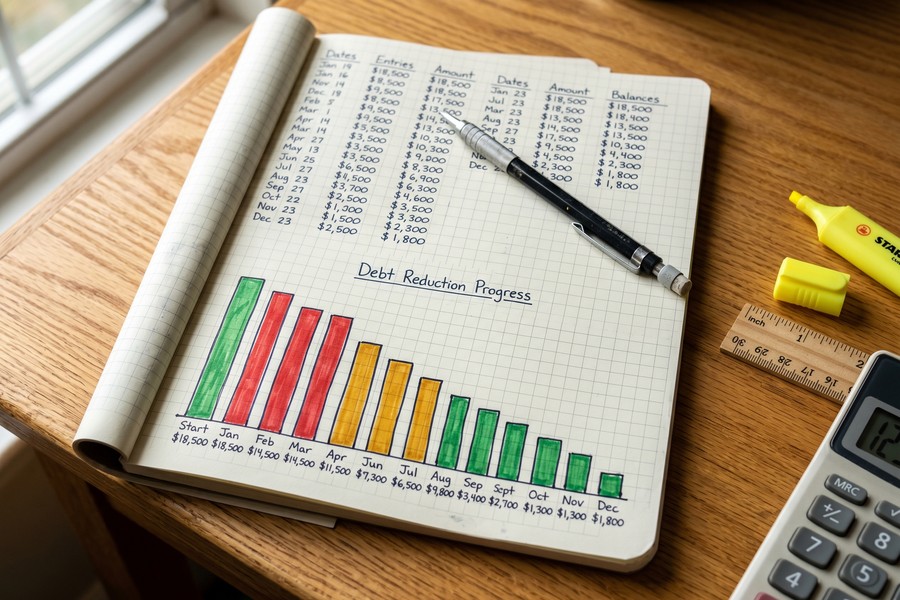
Spreadsheets remain one of the most effective debt tracking tools for visual, detail-oriented people. A simple debt tracking spreadsheet showing your balance, minimum payment, actual payment, interest charged, and principal reduced each month makes the cost of minimum payments concrete and visible. When you can see the numbers moving in real time, motivation tends to follow.
Studies on debt repayment behavior consistently show that people who track their debt payoff progress — whether with an app, spreadsheet, or visual chart — are significantly more likely to remain on their payoff plan than those who rely on mental accounting alone.
If your debt picture spans multiple loan types — credit cards, student loans, personal loans — a holistic approach to budgeting is essential. Tools like advanced budgeting frameworks beyond the 50/30/20 rule can help you allocate income efficiently across competing debt obligations.
The minimum payment warning box — mandated by the CARD Act since 2010 — must show how long it takes to pay off your balance making only minimum payments, as well as how much you’d need to pay monthly to eliminate the balance in 3 years. This information is on every statement. Most people never read it.
“The most powerful financial tool available to the average American credit card holder is a basic calculator and the will to use it. The math on minimum payments is not hidden — it’s printed on every statement. The real barrier is psychological, not informational.”
Real-World Example: Marcus and the $8,400 Credit Card Trap
Marcus was 34 years old when he first sat down to calculate the true cost of minimum payments on his three credit cards. He owed $4,200 on a store card charging 28.99% APR, $2,800 on a travel rewards card at 22.99%, and $1,400 on a card he’d used for an emergency home repair at 19.99%. Total debt: $8,400. Monthly minimums: approximately $252 combined. He had been paying minimums for two years and had reduced his principal by just $380.
When Marcus ran his numbers through the CFPB calculator, the results were jarring. Continuing at minimum payments, he would spend a projected $14,200 in interest over the next 22 years — paying a total of $22,600 for $8,400 in debt. His minimum payments were consuming nearly 9% of his take-home pay each month, month after month, with almost no end in sight. He had been funding his credit card companies’ profitability for years while building nothing for himself.
Marcus applied for a balance transfer card offering 0% APR for 18 months and transferred all three balances (paying a 3% transfer fee of $252). With no interest accruing, he committed to paying $500/month — $248 more than his old minimums — and directed a small additional amount toward a $1,000 emergency fund to prevent re-accumulation. Within 17 months, he had eliminated $8,400 in credit card debt entirely. Total interest paid: $0 (plus the $252 transfer fee). Total savings versus minimum payments: over $14,000.
One year after paying off his last card, Marcus’s credit score had risen 94 points. His credit utilization had dropped from 81% to 4%. He began investing the $500/month that had been going to debt payments. At 7% average annual returns, that $500/month over the next 20 years is projected to grow to approximately $261,000. The cost of minimum payments for Marcus wasn’t just $14,000 in interest — it was a potential $261,000 in retirement wealth that he nearly lost to financial inertia.
Your Action Plan
-
Calculate your exact payoff timeline today
Use the CFPB’s free credit card payoff calculator or Bankrate’s debt repayment tool. Enter your exact balance, APR, and current minimum payment. Write down the payoff date and total interest cost — seeing those numbers concretely is the most powerful motivator for change.
-
List every balance, rate, and minimum payment
Create a simple spreadsheet or use a notes app. For each card, record: current balance, APR, minimum payment, and actual monthly charge. This single document gives you the complete picture of your debt and forms the foundation of your payoff plan.
-
Set up a starter emergency fund before accelerating payoff
Before doubling down on debt payments, save $1,000–$2,000 in a separate high-yield savings account. This prevents the cycle of paying down debt only to add it back during unexpected expenses. Once the buffer exists, redirect all available income to debt elimination.
-
Call your credit card issuers and ask for a rate reduction
Call the number on the back of each card. Reference your payment history and ask specifically: “I’d like to request a lower interest rate on this account.” According to CreditCards.com data, 76% of cardholders who ask receive a reduction. Even a 5-point reduction on a $6,000 balance saves hundreds over the payoff period.
-
Evaluate a balance transfer for your highest-rate card
If your credit score qualifies you (generally 670+), a 0% balance transfer card can eliminate interest for 12–21 months. Compare transfer fees (3–5%) against projected interest savings. Use the transfer window aggressively — commit to a fixed monthly payment that eliminates the balance before the promotional rate expires.
-
Choose and implement either the avalanche or snowball method
Pay minimums on all cards except your target card. Direct every extra dollar to that one account. If you value mathematical efficiency, target the highest-APR card first (avalanche). If you need motivational wins, target the smallest balance first (snowball). Either method will save you thousands compared to minimum payments on all cards.
-
Automate your payments above the minimum
Set up a recurring payment that is higher than your minimum — even $50 more per month makes a measurable difference. Automation removes the decision from the monthly equation, preventing the “I’ll pay extra next month” procrastination that keeps people in debt for years longer than necessary.
-
Track your progress monthly and adjust as income changes
Review your balances once a month. Any unexpected income — a bonus, tax refund, freelance payment — should go directly to your highest-rate debt as a lump-sum payment. A single $500 payment to a 22% APR balance eliminates roughly $110 per year in future interest charges immediately.
Frequently Asked Questions
What exactly is a minimum payment on a credit card?
A minimum payment is the smallest amount your credit card issuer will accept each month without declaring your account delinquent. It is typically calculated as either a flat dollar amount (often $25–$35), a percentage of your balance (1–2%), or a percentage plus that month’s interest and fees — whichever is greater. Paying only this amount keeps your account current but results in extremely slow principal reduction and massive interest accumulation over time.
How long does it actually take to pay off a $5,000 credit card balance making only minimum payments?
At a typical 22% APR with a 2% minimum payment formula, paying only the minimum on a $5,000 balance will take approximately 17–19 years. During that time, you’ll pay between $6,300 and $8,200 in interest alone — far exceeding the original balance. Increasing to a fixed $200/month payment cuts the repayment period to about 3 years and reduces total interest to under $2,000.
Will paying only the minimum hurt my credit score?
Paying the minimum on time does not directly harm your credit score — late or missed payments cause the most credit damage. However, paying only minimums keeps your balance high relative to your credit limit, which means your credit utilization ratio stays elevated. High utilization (above 30% of available credit) significantly suppresses your FICO score, which can cost you access to better loan rates and financial products over time.
Are minimum payments set by law, or does each credit card company set its own?
Each issuer sets its own minimum payment formula, subject to broad federal guidelines. The CARD Act of 2009 requires that minimum payments be sufficient to pay off the balance “within a reasonable period,” but no specific timeline is mandated. This regulatory gap allows issuers to use formulas that technically comply with the law while still producing 20–30 year repayment timelines for cardholders who pay only the minimum each month.
What is the minimum payment warning box on my credit card statement?
The minimum payment warning is a federally mandated disclosure box required on every credit card statement since 2010. It shows two pieces of information: how long it will take to pay off your balance making only minimum payments, and how much you need to pay each month to eliminate the balance in exactly three years. Many cardholders overlook this box, but it contains the most honest cost-of-debt information on the entire statement.
Should I stop paying minimums and pay more if I can’t afford a large increase?
Yes — even a small increase above the minimum produces meaningful savings. Paying just $25–$50 more per month on a $5,000 balance can save hundreds in interest and shave years off the repayment timeline. You don’t need to find hundreds of extra dollars immediately. Start with whatever you can add consistently, then increase that amount as your cash flow improves.
Is it ever smart to pay the minimum intentionally?
In limited circumstances, yes. During genuine financial emergencies — job loss, major medical expenses — preserving cash may legitimately take priority over accelerated debt payoff for one to three months. If a card currently carries a 0% introductory rate and you have a funded plan to pay it off before that rate expires, paying the minimum temporarily while building savings can also make sense. These are exceptions, not strategies. Making minimums a permanent default is always financially costly.
How does a balance transfer affect the cost of minimum payments?
A balance transfer to a 0% APR promotional card can dramatically reduce — or eliminate — interest costs for the duration of the promotional period (typically 12–21 months). The cost of minimum payments drops to essentially zero in interest terms, meaning every dollar of your payment goes toward principal. The transfer fee (3–5%) is almost always far less than the interest you’d pay remaining on a high-rate card. The critical rule: pay off the transferred balance completely before the promotional rate expires.
What is negative amortization, and can it happen with credit cards?
Negative amortization occurs when your monthly payment is less than the interest charged that month, causing your balance to grow even though you made a payment. This can happen with credit cards that have very low flat minimums (e.g., $25) on high-interest balances. If your card charges $90/month in interest but your minimum is $25, your balance increases by $65 that month despite your payment. This is legal and more common than most cardholders realize — always verify that your payment exceeds your monthly interest charge.
How does the cost of minimum payments compare to other types of debt?
Credit card debt is among the most expensive forms of consumer debt due to its high variable APR (currently averaging over 21%). By comparison, federal student loans typically carry rates of 5–8%, personal loans from reputable lenders range from 8–15% for good-credit borrowers, and mortgage rates are generally well below 8%. The cost of minimum payments is particularly destructive on credit cards because the compounding rate is so high — what takes 3 years to accumulate can take 20 years to eliminate paying only minimums.
Sources
- Federal Reserve — Consumer Credit Statistical Release (G.19)
- Consumer Financial Protection Bureau — What Is a Minimum Payment?
- Consumer Financial Protection Bureau — Credit Card Payoff Calculator
- Harvard Business Review — To Pay Off Loans, Pay Attention to the Ones You’re Ignoring
- Federal Reserve — Minimum Payments and Debt Paydown in Consumer Credit Cards (Research Paper)
- Bankrate — The True Cost of Making Only Minimum Credit Card Payments
- NerdWallet — Credit Card Minimum Payments: What They Are and How They Work
- CreditCards.com — Credit Card Statistics and Industry Data
- myFICO — Credit Utilization and Your FICO Score
- Federal Reserve — Anchoring Effects in Credit Card Minimum Payments (Research Paper)
- Consumer Financial Protection Bureau — Consumer Credit Card Market Report 2023
- Urban Institute — The Credit Card Debt Trap