

Imagine applying for your first car loan and watching the lender’s eyes glaze over the moment they pull your file. You have a steady job, a decent credit score, and a realistic budget — but $47,000 in student loans sits on your record like a red flag. Getting an auto loan with student debt feels less like a financial transaction and more like an interrogation you’re destined to fail. Millions of young borrowers face this exact wall every year, and most don’t know there’s a way through it.
The numbers behind this problem are staggering. According to the Federal Student Aid portfolio data, Americans collectively carry over $1.6 trillion in federal student loan debt. Meanwhile, the average monthly student loan payment hovers around $393, according to the Education Data Initiative — a figure that eats directly into the debt-to-income ratio lenders use to approve car loans. Roughly 43 million borrowers are navigating this squeeze, and first-time car buyers are the most vulnerable group because they’re also the least likely to have established credit histories or co-signers lined up.
This guide breaks down exactly how one first-time buyer — with $51,000 in student loans and a 672 credit score — walked away with an approved auto loan at a competitive rate. You’ll learn what lenders actually look for, how to calculate and fix your debt-to-income ratio before applying, which loan types favor borrowers with student debt, and what steps to take in the 60 to 90 days before you ever walk into a dealership.
Key Takeaways
- Borrowers with student debt can qualify for auto loans, but lenders typically want a debt-to-income ratio below 43% — ideally under 36% — including the new car payment.
- The average student loan payment of $393/month reduces auto loan purchasing power by roughly $8,000–$12,000 on a 60-month loan term.
- A credit score of 661 or higher qualifies borrowers for “prime” auto loan rates, which averaged 6.89% for new cars in Q1 2024, according to Experian.
- Getting pre-approved before visiting a dealership can save borrowers an average of $1,500–$3,000 over the life of a loan by removing dealer markup from the equation.
- Income-driven repayment (IDR) plans can lower the student loan payment figure lenders use to calculate DTI, sometimes by $100–$200/month — a meaningful difference in loan eligibility.
- First-time buyers who add a creditworthy co-signer reduce their average interest rate by 1.5–3 percentage points, saving $1,200–$2,800 on a $25,000 auto loan over 60 months.
In This Guide
- How Lenders View Student Debt When Evaluating Auto Loans
- Debt-to-Income Ratio: The Number That Makes or Breaks Your Approval
- How Your Credit Score Interacts With Student Loan Debt
- Loan Types That Work Best for Borrowers With Student Debt
- Strategies to Reduce the Impact of Student Debt Before Applying
- Getting Pre-Approved for an Auto Loan With Student Debt
- Choosing the Right Vehicle to Maximize Approval Odds
- Using a Co-Signer and Down Payment to Strengthen Your Application
- Navigating the Dealership When You Have Student Loans
How Lenders View Student Debt When Evaluating Auto Loans
Most first-time borrowers assume a lender’s primary concern is their credit score. In reality, student loan obligations affect the underwriting picture in three distinct ways: they inflate your monthly debt load, they signal financial complexity, and — if you’ve ever missed a payment — they can actively damage your credit profile.
Lenders don’t just look at your balance. They look at what you owe every month. A $50,000 student loan on a standard 10-year repayment plan generates roughly $500–$550 in monthly payments. That’s money the lender counts against you before a single car payment enters the picture.
The Difference Between Deferred and Active Loans
If your student loans are in deferment or forbearance, lenders still count them. Fannie Mae guidelines — widely used as a benchmark across consumer lending — require lenders to count 1% of the total outstanding student loan balance as the monthly obligation if the payment is deferred. On a $50,000 balance, that’s $500/month counted against your DTI even if you’re not paying a dime right now.
Some lenders use a more lenient calculation — 0.5% of the balance — but this varies widely by institution. It pays to ask your lender directly which methodology they use before assuming deferment protects your DTI.
What Lenders Actually Want to See
Beyond the raw numbers, lenders want to see payment history consistency on your student loans. A single 90-day late payment can drop a credit score by 60–110 points, according to FICO. Lenders also want stable, verifiable income — W-2 employment is easiest to document, but self-employed borrowers can qualify with two years of tax returns and bank statements.
Some lenders distinguish between federal and private student loans when assessing risk. Federal loans have income-driven repayment options that cap payments at 5–10% of discretionary income — a flexibility that can actually work in your favor during underwriting if you’re already enrolled in an IDR plan.
Lenders categorize borrowers into risk tiers that directly determine interest rate offers. Understanding where you fall before you apply is the single most powerful piece of preparation you can do.
| Borrower Profile | Typical Credit Score | Avg. Auto Loan Rate (New, 2024) | Lender Stance on Student Debt |
|---|---|---|---|
| Super Prime | 781–850 | 5.08% | Student debt rarely disqualifies if DTI is clean |
| Prime | 661–780 | 6.89% | DTI scrutinized; IDR plans can help |
| Near-Prime | 601–660 | 9.62% | Student debt is a red flag; co-signer often needed |
| Subprime | 501–600 | 12.85% | Specialized lenders required; rates spike sharply |
| Deep Subprime | 300–500 | 14.18% | Approval unlikely without large down payment or co-signer |
Source: Experian State of the Automotive Finance Market, Q1 2024.
Debt-to-Income Ratio: The Number That Makes or Breaks Your Approval
Your debt-to-income ratio (DTI) is the percentage of your gross monthly income consumed by debt payments. It is, without question, the single most critical number when applying for an auto loan with student debt. Lenders typically want your total DTI — including the new car payment — to stay below 43%, with most preferring under 36%.
The math is straightforward but the implications aren’t always obvious. If you earn $4,500/month gross and your student loan payment is $400/month, you’ve already used 8.9% of your DTI budget. A car payment of $450/month brings your debt-related expenses to $850 — or 18.9% DTI. That still leaves room, but add credit card minimums or a personal loan and the picture changes fast.
How to Calculate Your Current DTI
Add up all monthly minimum debt payments: student loans, credit cards, personal loans, any existing car payments, and any other installment obligations. Divide that total by your gross monthly income (before taxes). Multiply by 100 to get the percentage.
For example: $400 (student loan) + $150 (credit card minimums) + $450 (proposed car payment) = $1,000. Divided by $4,500 gross income = 22.2% DTI. That’s well within the approval zone for most lenders.
According to the Consumer Financial Protection Bureau, borrowers with a DTI above 43% are significantly more likely to experience loan default. Most conventional auto lenders cap approvals at 45–50% DTI, but rates worsen sharply above 36%.
The “Back-End” vs “Front-End” DTI Distinction
Front-end DTI covers only housing costs relative to income. Back-end DTI covers all debt obligations — and that’s what auto lenders use. Most borrowers are surprised to learn that their student loan payment is weighted the same as any other recurring debt. There’s no special exemption for educational debt in traditional auto loan underwriting.
Some credit unions and community banks take a more holistic view, reviewing why your DTI is elevated and weighing your employment trajectory. This is one reason why shopping multiple lender types — not just big banks — matters enormously when you’re carrying student debt.

How Your Credit Score Interacts With Student Loan Debt
Student loans affect your credit score in ways that are both harmful and — perhaps surprisingly — beneficial. Understanding this dual nature helps you position your credit profile strategically before you apply.
On the negative side: late or missed student loan payments cause significant credit score damage. Even one 30-day late payment can drop a score by 50–80 points. On the positive side, student loans are installment accounts, and successfully managing them builds the credit mix and payment history that make up 45% of your FICO score.
Credit Mix and Length of History
FICO scores reward borrowers who have successfully managed multiple types of credit: revolving accounts (credit cards) and installment accounts (student loans, personal loans). If your student loan is your only form of credit, adding a car loan actually diversifies your credit mix — which can nudge your score upward by 5–15 points over the first 12 months of repayment.
Length of credit history accounts for 15% of your FICO score. If your student loans have been active for 3–7 years with a clean payment record, that history works in your favor when lenders review your file.
Hard Inquiries and Rate Shopping
When you apply for an auto loan, lenders do a hard inquiry on your credit report. Each hard inquiry can drop your score by 5–10 points temporarily. However, FICO and VantageScore both have rate-shopping windows: multiple auto loan inquiries within a 14–45 day window count as a single inquiry. Always do your rate shopping within that window to minimize score impact.
Before applying for any auto loan, pull your free credit reports from AnnualCreditReport.com and dispute any errors. One study by the FTC found that 25% of consumers had errors on their credit reports significant enough to affect their score. Fixing an error can raise your score by 20–50 points — enough to move you into a better rate tier.
For a deeper look at how to read and interpret your credit report before applying, see our guide on how to read a credit report for the first time without getting overwhelmed.
Loan Types That Work Best for Borrowers With Student Debt
Not all auto loans are created equal — and some lending products are far more accommodating to borrowers carrying significant student debt. Knowing where to look dramatically changes your approval odds and the interest rate you’ll pay.
Credit Unions vs. Traditional Banks vs. Online Lenders
Credit unions are member-owned, nonprofit institutions that typically offer rates 1–2% lower than traditional banks for borrowers with the same credit profile. They also tend to be more flexible with DTI thresholds, especially if you’ve been a member for several years. The National Credit Union Administration reports that the average credit union auto loan rate was 6.61% for a 60-month new car loan in early 2024 — noticeably lower than bank averages.
Traditional banks offer convenience and speed, but their underwriting is often more algorithmic and less forgiving on DTI spikes caused by student debt. Online lenders — platforms like LightStream, PenFed, and Capital One Auto Finance — offer competitive rates and fast approvals, often with soft-pull pre-qualification tools that let you check rates without affecting your credit score.
| Lender Type | Avg. Rate Range (60-Mo New) | DTI Flexibility | Best For |
|---|---|---|---|
| Credit Union | 5.5%–7.5% | High — human review common | Members with moderate DTI or complex income |
| Traditional Bank | 6.0%–9.0% | Medium — algorithm-driven | Existing customers with strong credit scores |
| Online Lender | 5.8%–12.0% | Varies widely by platform | Fast approvals; good for comparison shopping |
| Captive Finance (Dealer) | 0%–18%+ | Low — profit-driven | Buyers with excellent credit chasing promo rates |
New vs. Used Car Loans With Student Debt
Used car loans carry higher interest rates on average — 11.35% for prime borrowers in Q1 2024, compared to 6.89% for new cars, according to Experian. However, a lower vehicle purchase price can offset that rate difference entirely. A $15,000 used car at 9% may produce a lower monthly payment than a $32,000 new car at 6.5%.
For borrowers managing student debt, the monthly payment impact matters more than the sticker rate. Explore the full financial comparison in our deep dive on whether a new or used car loan actually saves you more money.
“When a borrower has significant student loan obligations, we’re not just looking at credit score — we’re stress-testing the full monthly budget. A buyer who brings a pre-approved loan from their credit union is already showing financial discipline, and that matters in our evaluation.”
Strategies to Reduce the Impact of Student Debt Before Applying
You don’t have to pay off your student loans before buying a car — but you can take targeted steps in the 60 to 90 days before your application to meaningfully reduce how student debt impacts your auto loan eligibility.
Enrolling in an Income-Driven Repayment Plan
If you have federal student loans, switching to an income-driven repayment (IDR) plan can cut your required monthly payment to as little as 5–10% of your discretionary income — often hundreds of dollars less than a standard repayment plan. Because lenders use your current required monthly payment (not your balance) to calculate DTI, a lower IDR payment directly improves your DTI ratio.
For example, if your standard payment is $520/month but you qualify for an IDR payment of $190/month, your DTI improves by $330/month — enough to make the difference between approval and denial on a $25,000 car loan. For a full breakdown of how IDR plans work, our guide on income-driven repayment plans covers every option in detail.
Paying Down High-Utilization Credit Cards
Credit card utilization is the second-largest factor in your credit score (30% of FICO). Carrying balances above 30% of your credit limit suppresses your score. Paying down even $500–$1,000 in credit card balances can raise your score by 10–30 points within one billing cycle — potentially moving you into a better interest rate tier before you apply.
Paying off a $2,000 credit card balance at 30% utilization can improve your credit score by 15–25 points within 30 days — and that score improvement, applied to a $25,000 auto loan, could shift your interest rate from 9.62% to 6.89%, saving you over $2,000 over a 60-month loan term.
Avoiding New Debt Applications Before Your Auto Loan
Every new credit application creates a hard inquiry and, if approved, adds a new account that temporarily lowers your average account age. Both effects drag your score down in the short term. In the 90 days before applying for a car loan, avoid applying for new credit cards, personal loans, or any other financing.
Also avoid closing old credit card accounts — counterintuitively, this raises your utilization ratio (by reducing available credit) and shortens your average account age.
Getting Pre-Approved for an Auto Loan With Student Debt
Pre-approval is the single most powerful tool a borrower with student debt can use before shopping for a car. It converts you from a supplicant at a dealership into a cash buyer with a known budget — and it protects you from dealer financing markups that can add 1–3 percentage points to your rate.
What Pre-Approval Actually Means
A pre-approval is a conditional commitment from a lender stating the maximum loan amount, interest rate, and terms they’ll offer based on a full credit check and income verification. It is more binding than pre-qualification (which uses a soft pull and self-reported data). For borrowers with student debt, the difference between the two matters — understand it fully before applying. Our breakdown of auto loan pre-approval vs pre-qualification explains exactly what lenders look at in each process.
Pre-approval letters typically last 30–60 days, giving you a realistic shopping window. During that window, you’re shielded from rate increases and empowered to negotiate on vehicle price rather than monthly payment.
Documents You’ll Need to Gather
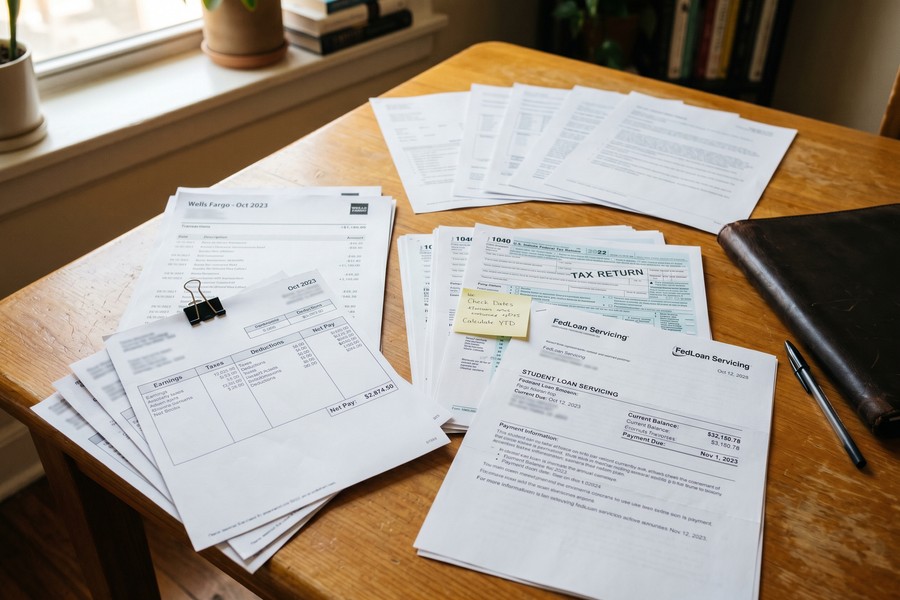
Lenders processing borrowers with student debt typically require more documentation than a standard applicant. Prepare the following before you begin:
- Two to three months of recent pay stubs (or tax returns if self-employed)
- Bank statements showing savings and consistent deposits
- Student loan account statements showing current monthly payment amount
- Proof of income-driven repayment enrollment (if applicable)
- Valid government-issued ID and proof of current address
- Proof of insurance or at least a quote in your name
Some lenders pull your student loan details from the National Student Loan Data System (NSLDS) during underwriting. If your reported balance or payment status doesn’t match what you’ve told them, it can trigger additional scrutiny or denial. Always be transparent about all outstanding student debt — even loans in deferment — when completing a loan application.
Choosing the Right Vehicle to Maximize Approval Odds
Vehicle selection is underrated as an approval strategy. The make, model, age, and price of the car you choose affects not just your monthly payment but also the lender’s willingness to finance it — and the rate they’ll offer.
Loan-to-Value Ratio and Why It Matters
Lenders care about the loan-to-value (LTV) ratio — the loan amount compared to the car’s actual market value. Borrowing 100% of a vehicle’s value is riskier for a lender than borrowing 80%. Most lenders prefer an LTV at or below 100% for new cars and 80–90% for used vehicles, because used cars depreciate faster and carry more market risk.
Choosing a car with strong resale value — like a Toyota Camry, Honda CR-V, or Subaru Outback — makes lenders more comfortable because the collateral holds its value better. Buying a car that’s already 5+ years old at a high LTV raises underwriting red flags, especially for borrowers already flagged for elevated DTI from student loans.
Keeping Total Loan Amount Realistic
A common mistake among first-time buyers with student debt is maximizing the loan amount their pre-approval allows. Just because a lender approves you for $30,000 doesn’t mean a $30,000 car fits your actual monthly budget. Financial advisors generally recommend keeping total vehicle costs — payment, insurance, gas, maintenance — to no more than 15–20% of your take-home pay.
For a borrower earning $3,800/month take-home with a $400 student loan payment, keeping the car payment under $350/month is a wise target. That constrains the vehicle price to roughly $18,000–$22,000 on a 60-month loan at current prime rates.
| Vehicle Price | Loan Term | Rate (6.89%) | Monthly Payment | Total Interest Paid |
|---|---|---|---|---|
| $15,000 | 60 months | 6.89% | $295 | $2,698 |
| $20,000 | 60 months | 6.89% | $393 | $3,580 |
| $25,000 | 60 months | 6.89% | $491 | $4,475 |
| $30,000 | 60 months | 6.89% | $589 | $5,370 |
Using a Co-Signer and Down Payment to Strengthen Your Application
Two levers that dramatically improve approval odds and interest rates for borrowers with student debt: a qualified co-signer and a meaningful down payment. Either one alone helps. Both together can transform a borderline application into a straightforward approval.
How a Co-Signer Changes the Equation
A co-signer with strong credit (720+) and low personal debt essentially vouches for your loan with their own financial profile. Lenders treat the application as reflecting the stronger borrower’s creditworthiness, which can move you from a near-prime rate of 9.62% into a prime rate of 6.89% — a difference of $1,800–$2,500 on a $25,000 loan over 60 months.
Be aware that the loan appears on the co-signer’s credit report as well. If you miss payments, their score suffers. This is a serious commitment, not a formality. Before bringing someone into this arrangement, read our detailed analysis of when adding a co-borrower actually hurts you — because in some situations, it can backfire.
Down Payment Strategy for Student Debt Borrowers
A larger down payment reduces the loan amount, which lowers your monthly payment and improves your LTV ratio — both of which make lenders more comfortable. Even a 10% down payment on a $20,000 car ($2,000) reduces your monthly payment by about $40 and signals financial responsibility to the underwriter.
Aim for at least 10% down on a used car and 20% on a new car if possible. New cars depreciate roughly 20% in the first year — meaning a $0 down payment on a $30,000 car puts you “underwater” (owing more than the car is worth) almost immediately. This creates additional risk for both you and the lender.
According to Edmunds, the average down payment on a new car in the U.S. in 2023 was $6,780 — representing about 14.5% of the average transaction price of $46,700. First-time buyers putting down less than 10% are at significantly higher risk of going underwater on their loan within 12 months.
Navigating the Dealership When You Have Student Loans
Walking into a dealership without preparation is how borrowers with student debt end up overpaying by thousands of dollars. Dealers profit from financing arrangements — often receiving kickbacks from captive lenders for marking up rates — and a buyer who doesn’t have their own financing already secured is an easy target.
Leading With Your Pre-Approval
When you arrive at a dealership with a pre-approval letter in hand, you’ve shifted the power dynamic. You’re now shopping for a vehicle, not a monthly payment. This distinction is critical. Dealers love to anchor negotiations around monthly payment because it obscures the total cost of the loan. Always negotiate on the out-the-door price of the vehicle first, then layer in financing discussions separately.
If the dealer offers to beat your pre-approved rate by at least 0.5 percentage points, let them try — but never reveal your maximum approved amount. Common dealership mistakes that cost buyers thousands are detailed in our breakdown of 5 mistakes people make when financing a car at the dealership.
Add-Ons to Scrutinize or Decline
Dealers generate significant profit from the “F&I office” (finance and insurance) — the room where you sign paperwork and get pitched on extras. Common add-ons include extended warranties, gap insurance, paint protection, and credit life insurance. Some of these have genuine value; many do not.
Gap insurance is worth considering for first-time buyers who put less than 20% down — it covers the difference between what you owe and what the car is worth if it’s totaled. But you can often buy it cheaper through your auto insurer than through the dealer. Read our analysis of whether gap insurance on an auto loan is actually necessary before signing anything in that office.
“The F&I office is where dealerships make more per customer than anywhere else in the transaction. A first-time buyer with student debt who hasn’t done their homework is particularly vulnerable to add-ons that inflate the total loan cost by $2,000–$5,000.”
| Dealer Add-On | Typical Cost | Worth It? | Better Alternative |
|---|---|---|---|
| Gap Insurance | $400–$900 (rolled in) | Sometimes — if less than 20% down | Buy through your auto insurer (~$20–$40/yr) |
| Extended Warranty | $1,500–$4,000 | Rarely — unless high-mileage used car | Build a repair emergency fund instead |
| Paint/Fabric Protection | $300–$1,200 | No | DIY ceramic coat or fabric spray |
| Credit Life Insurance | $500–$2,000 | No | Term life insurance is far cheaper |
What to Do if You’re Denied
If your application is denied, you’re entitled to a written explanation under the Equal Credit Opportunity Act. Review the denial reason carefully — it usually points to the specific DTI, credit score, or documentation issue that tripped the underwriting algorithm. Most denial reasons are fixable within 60–120 days with targeted action.
Don’t panic and don’t immediately reapply. Each new application triggers another hard inquiry. Instead, address the root cause first. If student loan DTI was the issue, explore enrolling in an IDR plan, paying down other debts, or finding a co-signer before reapplying.
“Buy here, pay here” dealerships target borrowers who’ve been denied by traditional lenders — and their interest rates frequently exceed 20–30% APR. Avoid these arrangements entirely if possible. They report to credit bureaus inconsistently, meaning the loan may not even build your credit the way a conventional auto loan would.
“Borrowers who are denied once and immediately reapply at multiple lenders in a disorganized way often make their situation worse. A single focused reapplication strategy — after addressing the denial reason — is far more effective.”

According to Experian’s 2024 automotive finance report, borrowers who secured financing through a credit union or bank before visiting the dealership were 38% less likely to accept an extended loan term (72 or 84 months) that increases total interest costs dramatically over time.
A $25,000 auto loan at 6.89% over 60 months costs $4,475 in total interest. The same loan stretched to 84 months costs $6,348 in total interest — $1,873 more — while simultaneously keeping you underwater on the vehicle’s value for longer.
| Loan Term | Monthly Payment ($25,000 at 6.89%) | Total Interest | Risk for Student Debt Borrowers |
|---|---|---|---|
| 36 months | $771 | $2,754 | High monthly burden; not recommended with heavy student debt |
| 48 months | $598 | $3,694 | Moderate — good if DTI is below 35% |
| 60 months | $491 | $4,475 | Most common; balances payment and cost |
| 72 months | $423 | $5,476 | Lower payment but high total cost; underwater risk |
| 84 months | $375 | $6,348 | Avoid — long underwater period; excessive interest |
Real-World Example: How Marcus Got Approved for a $21,500 Auto Loan With $51,000 in Student Debt
Marcus, 26, had just landed his first full-time job as a data analyst earning $58,000/year ($4,833/month gross) in Atlanta. He had $51,000 in federal student loans on a standard 10-year repayment plan — monthly payment: $527. He also carried one credit card with a $1,200 balance on a $3,000 limit (40% utilization). His credit score was 672, and he had no previous auto loan history. When he applied at two national banks, both denied him — citing a DTI of 38% with the proposed car payment and a near-prime credit profile that made them uncomfortable with his student loan exposure.
Rather than reapplying immediately, Marcus spent 90 days making targeted changes. First, he enrolled in the SAVE income-driven repayment plan, which reduced his required monthly student loan payment from $527 to $187 — a $340/month reduction in his counted debt obligations. Second, he paid his credit card down to $600 (20% utilization), which pushed his score from 672 to 694 within two billing cycles. Third, he saved an additional $2,000 specifically for a down payment, bringing his total to $3,500. He also read up on how to get a first auto loan approved and followed the pre-approval strategy outlined there.
Armed with these changes, Marcus applied for pre-approval at his local credit union and two online lenders within a 10-day window. His credit union came back with an approval for up to $24,000 at 7.1% for 60 months — prime territory. He used the offer as leverage at the dealership, where the captive lender matched it at 6.9%. He purchased a 2022 Honda Civic with 28,000 miles for $21,500, put $3,500 down, and financed $18,000. His monthly payment: $356. His total DTI with the new car payment and the IDR student loan payment: 28.3% — safely within the approval sweet spot. Total interest paid over the life of the loan: $3,363.
The transformation took exactly 91 days from first denial to final approval. Marcus’s case illustrates that getting an auto loan with student debt isn’t about luck — it’s about understanding precisely which levers to pull and pulling them in the right order. The changes he made weren’t drastic, but they were surgical: a $340/month DTI reduction from IDR enrollment plus a 22-point score improvement from credit card paydown made all the difference. He also committed to paying the loan off in 48 months by making slightly larger payments — saving an additional $580 in interest and freeing up his budget faster. For a comparison of early payoff vs. investing the difference, see our analysis on whether to pay off your auto loan early or invest.
Your Action Plan
-
Calculate Your Current DTI Before Anything Else
Add up every monthly minimum debt payment — student loans, credit cards, personal loans — and divide by your gross monthly income. If your DTI (including a realistic car payment) exceeds 43%, do not apply yet. Identify which debts to address first to bring it below 36%.
-
Enroll in an Income-Driven Repayment Plan if You Have Federal Student Loans
Visit StudentAid.gov and use the Loan Simulator to find the IDR plan that minimizes your monthly required payment. Apply online — enrollment typically takes 2–4 weeks to process and update with loan servicers. Once active, request updated payment statements to show lenders your new lower payment amount.
-
Pay Down Credit Card Balances Below 20% Utilization
Identify any credit card with a balance above 30% of its credit limit and prioritize paying it down. This single action can raise your score by 10–30 points within one billing cycle. Use windfalls, tax refunds, or a month of reduced spending to accomplish this before applying.
-
Pull and Review Your Credit Reports for Errors
Visit AnnualCreditReport.com and pull all three bureau reports — Equifax, Experian, and TransUnion. Dispute any errors directly with the bureau online. The dispute process takes 30–45 days, so do this at least 60 days before you plan to apply for any auto loan.
-
Gather All Required Documentation in Advance
Compile pay stubs (2–3 months), bank statements (2–3 months), your student loan payment confirmation showing the current required monthly payment, and proof of address. Having this ready speeds up the pre-approval process significantly and prevents delays that force you to reapply.
-
Apply for Pre-Approval at Multiple Lenders Within a 14-Day Window
Target your primary credit union, at least one online lender (LightStream, Capital One, or PenFed), and one regional bank. Submitting all applications within 14 days ensures they count as a single hard inquiry. Compare the APR, loan term, and any fees — not just the monthly payment figure.
-
Choose a Vehicle Strategically — Price First, Features Second
Set a maximum out-the-door price based on your pre-approval and monthly budget (aim for a payment that keeps your total DTI below 36%). Prioritize vehicles with strong resale value and low total cost of ownership. Avoid stretching to a loan term longer than 60 months to manage a higher-priced vehicle.
-
Negotiate the Vehicle Price Before Discussing Financing
At the dealership, negotiate on the out-the-door price of the car first. Only reveal your pre-approval after you’ve agreed on price. Decline any add-ons in the F&I office that you haven’t researched in advance. Take the paperwork home to review before signing if needed — a reputable dealer will allow this.
Frequently Asked Questions
Can I get an auto loan with student debt if my credit score is below 650?
Yes — it’s possible, but your options narrow significantly below 650. Near-prime lenders and some credit unions will still work with you, but expect rates in the 9–13% range. A co-signer with strong credit (720+) is the most effective tool for borrowers with scores between 600 and 650. Improving your score by even 20–30 points before applying can unlock meaningfully better rates.
Do student loans in deferment hurt my auto loan application?
Yes — lenders still count deferred student loans against your DTI. Most use either 0.5% or 1% of your total outstanding balance as the assumed monthly payment. On a $40,000 balance, that’s $200–$400/month added to your debt load even though you’re not making payments. Enrolling in an IDR plan (if your income qualifies) can often produce a lower payment than these assumptions — and give you documented proof of a smaller monthly obligation.
How much student debt is too much to qualify for a car loan?
There’s no absolute cutoff — it depends on your income, credit score, and all other debt obligations. What matters is your DTI ratio. If your student loan payment plus proposed car payment plus other debts stay below 43% of gross income, most lenders will consider your application. A high-income borrower with $100,000 in student loans may qualify more easily than a lower-income borrower with $30,000 in student loans.
Will getting an auto loan hurt my ability to repay student loans?
It can if you overextend yourself. Adding a car payment to an already tight budget raises your monthly fixed expenses and reduces your ability to make extra student loan payments or handle unexpected expenses. Run the numbers honestly: if your total debt payments (student loans plus car plus all other debts) exceed 40% of take-home pay, you’re in a financially fragile position worth reconsidering before taking on an auto loan.
Should I refinance my student loans before applying for an auto loan?
It depends on the timing and outcome. Refinancing federal student loans into a private loan can lower your monthly payment — but it also eliminates IDR plan eligibility and federal forgiveness protections. If you’re considering this path, understand the full trade-off. Our guide on private student loan refinancing options covers the key considerations in detail. In general, using an IDR plan is safer for most federal borrowers than refinancing before an auto loan application.
Does income-driven repayment enrollment take time to show up for lenders?
Yes — typically 30–60 days after enrollment, your loan servicer will update your account to reflect the new required payment amount. Request a written confirmation letter or updated account statement showing your new IDR payment. This document is what you’ll present to auto lenders during underwriting to prove your current required monthly payment is lower than standard repayment amounts.
Is a longer loan term (72 or 84 months) a good idea for borrowers with student debt?
Only as a last resort. Longer loan terms lower monthly payments but significantly increase total interest paid — and keep you underwater (owing more than the car is worth) for much longer. For borrowers already managing student loan debt, adding years of additional financial exposure on a depreciating asset is a compounding risk. If the only way you can afford the monthly payment is with a 72+ month term, the vehicle is likely beyond your current budget.
Can an auto loan with student debt help build my credit history?
Yes — if managed responsibly, an auto loan adds an installment account to your credit profile, which diversifies your credit mix and builds payment history (the single most important factor in your FICO score). Making every payment on time for 12 consecutive months can raise your score by 20–40 points. This credit building also benefits your future ability to refinance student loans at better rates or qualify for a mortgage.
What’s the best loan term for a first-time buyer with student debt?
For most first-time buyers managing student loans, a 48 to 60-month term strikes the best balance between a manageable monthly payment and reasonable total interest costs. Sixty months is the most common term and the standard against which most rates are benchmarked. If your budget allows, choosing 48 months saves hundreds in interest and reduces your underwater exposure period.
What happens to my auto loan if I lose my job and can’t make payments?
Unlike federal student loans, auto loans have no income-driven repayment or deferment options built into the product. Missing payments triggers late fees within 10–15 days and credit score damage within 30 days. After 60–90 days of nonpayment, the lender can repossess the vehicle — often without advance warning. Build an emergency fund covering at least 3 months of combined debt payments before taking on a car loan alongside student debt obligations.
Sources
- Federal Student Aid — Student Loan Portfolio Data
- Experian — Auto Loan Rates by Credit Score, Q1 2024
- Consumer Financial Protection Bureau — Auto Loan Trends
- Federal Trade Commission — Equal Credit Opportunity Act
- National Credit Union Administration — Industry Data
- Federal Student Aid — Income-Driven Repayment Plans Overview
- FICO — Understanding Credit Score Ranges
- Edmunds — How Much Car Can You Afford?
- Bankrate — Average Auto Loan Interest Rates by Credit Score
- Education Data Initiative — Average Student Loan Payment Statistics
- AnnualCreditReport.com — Free Credit Report Access
- Federal Trade Commission — Credit Report Error Study
- LendingTree — Auto Loan Statistics and Trends