

The average American household carries over $10,000 in credit card debt alone — and for a single mother earning $42,000 a year, that number can feel like a life sentence. If you’ve ever stared at a stack of bills after putting the kids to bed, wondering how anyone manages to pay off debt low income without a financial windfall or a second full-time job, you’re not imagining the difficulty. It is hard. But it is also, with a specific strategy, completely doable.
The numbers are sobering. According to the U.S. Census Bureau, single mothers have a poverty rate nearly five times higher than married-couple families. The median income for a single-mother household sits around $42,000 — which means after taxes, childcare, rent, and groceries, there is often less than $200 left over each month. Yet the Federal Reserve reports that nearly 40% of Americans could not cover an unexpected $400 expense without borrowing money. The system is not designed with margin in mind for low-income single parents.
This guide tells the real story of how one single mother eliminated $22,000 in mixed debt — credit cards, a personal loan, and a medical bill — in 34 months on a $42,000 salary. You’ll get her exact budget breakdown, the specific debt payoff methods she used, the mistakes she nearly made, and a step-by-step action plan you can start this week. No gimmicks, no lottery wins, no second income required.
Key Takeaways
- A $42,000 annual salary (roughly $2,917/month after taxes and benefits) left approximately $380/month for debt repayment after a full budget audit.
- Using the debt avalanche method, $22,000 in debt was eliminated in 34 months — saving an estimated $1,840 in interest compared to minimum payments alone.
- Negotiating a medical bill down from $4,200 to $2,100 — a 50% reduction — freed up $87/month immediately.
- A $1,000 starter emergency fund prevented three potential credit card charges totaling $740 over the repayment period.
- Side income averaging $280/month from flexible gig work accelerated payoff by approximately 9 months.
- Credit score improved from 588 to 701 over the 34-month period, qualifying her for a 4.9% auto loan rate vs. the 14.2% she had previously been paying.
In This Guide
- The Full Debt Breakdown: What $22,000 Actually Looked Like
- The Budget Audit: Finding Money That Was Already There
- Debt Payoff Methods: Avalanche vs. Snowball on a Tight Budget
- Negotiating Debt Down: The Calls Most People Never Make
- Side Income Without a Second Job: Realistic Options for Single Parents
- The Emergency Fund’s Role in Staying on Track
- Credit Score Recovery During the Payoff Process
- Mindset and Systems: Why Discipline Alone Isn’t Enough
- Common Pitfalls That Derail Low-Income Debt Payoffs
The Full Debt Breakdown: What $22,000 Actually Looked Like
Before any plan could be made, every dollar of debt had to be mapped. This is a step most people skip — and it’s why most debt payoff attempts fail within 90 days. The $22,000 was not one lump sum. It was five separate accounts with five different interest rates, minimum payments, and creditor policies.
The Debt Inventory
| Debt Type | Balance | Interest Rate | Min. Payment |
|---|---|---|---|
| Credit Card A (retail) | $3,400 | 28.99% APR | $85/mo |
| Credit Card B (major bank) | $5,800 | 22.49% APR | $130/mo |
| Personal Loan | $7,500 | 18.75% APR | $195/mo |
| Medical Bill | $4,200 | 0% (collections risk) | $100/mo |
| Store Credit Card | $1,100 | 26.99% APR | $35/mo |
Total minimum payments came to $545 per month. That figure alone consumed nearly 22% of the take-home income — before rent, food, or utilities were paid. Understanding this total was the first psychological shock that motivated real change.
Why the Medical Bill Was the Biggest Hidden Risk
The $4,200 medical bill carried 0% interest — but it was already 8 months past due and one letter away from being sent to collections. A collections entry on a credit report can drop a score by 50 to 100 points according to the Consumer Financial Protection Bureau. That would have made refinancing, renting an apartment, or even getting a cell phone plan significantly harder.
Addressing the medical bill through negotiation — not just the high-interest credit cards — became a top priority. This is a counterintuitive move that most debt payoff guides miss entirely.
As of July 2022, the three major credit bureaus — Equifax, Experian, and TransUnion — agreed to remove medical debt under $500 from credit reports. Debts over $500 are now only reported after 12 months of non-payment, giving patients more time to resolve them before their credit is damaged.
The Budget Audit: Finding Money That Was Already There
The most common belief among people trying to pay off debt low income is that there’s simply nothing left to cut. This is almost never entirely true. A thorough budget audit — not a quick glance at bank statements — typically reveals 8-12% of monthly spending that can be redirected without destroying quality of life.
The Monthly Income Reality
A $42,000 annual salary breaks down to $3,500/month gross. After federal and state taxes, Social Security, Medicare, and a small health insurance premium for herself and her daughter, take-home pay was approximately $2,917/month. Every budget decision had to be made from that number — not the gross salary that looks better on paper.
| Expense Category | Before Audit | After Audit | Monthly Savings |
|---|---|---|---|
| Rent | $1,050 | $1,050 | $0 |
| Groceries | $520 | $380 | $140 |
| Subscriptions | $87 | $22 | $65 |
| Dining out | $210 | $80 | $130 |
| Utilities | $165 | $148 | $17 |
| Transportation | $340 | $290 | $50 |
| Childcare | $480 | $480 | $0 |
| Personal/misc. | $220 | $110 | $110 |
The audit revealed $512/month in cuttable spending — not through extreme sacrifice, but through deliberate choices. Canceling four streaming services kept one. Switching to a store-brand grocery list cut food costs by 27%. Reducing dining out from weekly to twice a month was hard at first and became normal by month three.
The Zero-Based Budget Framework
The method that made this sustainable was zero-based budgeting — assigning every dollar a job before the month begins so that income minus expenditures equals zero. This is not the same as spending everything. It means every dollar is intentionally directed, including debt payments and savings. If you want to explore this method in depth, our guide on cash envelope system vs. zero-based budgeting compares both approaches with real examples.
After the budget audit and debt minimum payments ($545), the revised plan left $380/month in discretionary debt payoff money. That number was the engine of the entire 34-month plan.
Run your budget audit using 90 days of actual bank statements — not what you think you spend. Most people underestimate dining and subscription costs by 30-40% when they estimate from memory alone.

Debt Payoff Methods: Avalanche vs. Snowball on a Tight Budget
The two most widely recommended debt elimination strategies are the debt avalanche (pay highest interest first) and the debt snowball (pay smallest balance first). On a tight income, choosing the right one is not just a math problem — it’s a psychology problem.
Why the Avalanche Won Here
With five debts ranging from $1,100 to $7,500, the debt avalanche made mathematical sense. The retail credit card at 28.99% APR was costing approximately $82/month in interest alone on a $3,400 balance. Paying that off first stopped the bleeding faster in real dollar terms.
Running minimum payments only on the original $22,000 debt load would have taken approximately 11.5 years and cost $14,300 in interest. The avalanche strategy cut the timeline to 34 months and reduced interest paid to $6,200 — a savings of $8,100.
The snowball’s psychological wins — eliminating a full account faster — were less important here because the smallest debt ($1,100 store card) had a high enough interest rate (26.99%) that targeting it third instead of first still made sense. The sequencing was: retail card (28.99%), store card (26.99%), major bank card (22.49%), personal loan (18.75%), medical bill (negotiated separately).
When Snowball Makes More Sense
For people with very low motivation or a history of quitting debt payoff plans, the snowball’s quick wins can be worth the extra interest cost. A 2016 study published in the Journal of Consumer Research found that focusing on paying off one account at a time — regardless of interest rate — improved task completion rates. If you’ve failed at debt payoff before, the snowball may keep you in the game long enough to win.
“The best debt payoff plan is the one you’ll actually stick to. Mathematical optimization means nothing if you abandon the strategy in month four.”
Negotiating Debt Down: The Calls Most People Never Make
One of the most underused tools available to anyone trying to pay off debt low income is simple negotiation. Creditors — especially medical providers and original creditors on accounts that haven’t yet gone to collections — regularly settle for less than the full balance or offer hardship programs that reduce interest rates temporarily.
The Medical Bill Negotiation
The $4,200 hospital bill was addressed first, before any extra payments went to credit cards. A single phone call to the hospital’s billing department, with an explanation of single-parent financial hardship and a request for their financial assistance program, resulted in the bill being reduced to $2,100. That is a 50% reduction — achieved in one 22-minute phone call.
Many hospitals are required to offer charity care or financial assistance under the Affordable Care Act. Nonprofit hospitals in particular must have financial assistance policies in place. Ask specifically for the “financial counselor” or “patient advocate,” not the general billing line — the language you use matters.
The IRS requires nonprofit hospitals to have written financial assistance policies. According to the Kaiser Family Foundation, roughly 60% of U.S. hospitals are nonprofit — meaning the majority of Americans with hospital bills have access to some form of assistance, regardless of income level.
The Credit Card Hardship Program Call
Two of the three credit card companies offered temporary hardship programs when asked directly. The major bank card reduced the APR from 22.49% to 9.99% for 12 months. The retail card declined — but the interest that had already accrued was not waived. Hardship programs typically require you to close the card or stop using it, which is fine when you’re in debt payoff mode.
Asking for a lower interest rate is not a credit application — it does not trigger a hard inquiry on your credit report. The worst a creditor can say is no. In this case, one yes on the largest credit card balance saved approximately $340 in interest over the hardship period.
Debt settlement companies that promise to negotiate all your debts for a fee often charge 15-25% of the settled amount and can seriously damage your credit score in the process. Negotiate directly with creditors yourself — it’s free and far less risky.
Side Income Without a Second Job: Realistic Options for Single Parents
The budget audit and negotiations freed up $380/month for extra debt payments. But the plan was accelerated significantly by adding a modest side income — one that worked around a school-age child’s schedule and didn’t require a second traditional job.
What Actually Generated Income
| Income Source | Monthly Average | Hours/Week | Flexibility |
|---|---|---|---|
| Freelance data entry | $120 | 4-5 hrs | High (asynchronous) |
| Selling items online | $95 | 2-3 hrs | High (self-directed) |
| Weekend childcare swap | $65 | 4 hrs | Medium (scheduled) |
Total average side income: $280/month. This was applied entirely to the highest-interest debt each month, functioning as a turbocharger on the avalanche method. Over 25 months (the side income phase of the plan), this contributed an additional $7,000 toward debt reduction.
The Math of Extra Payments
On a $3,400 balance at 28.99% APR, adding $100/month to the minimum payment reduces payoff time from 52 months to 18 months — a 34-month difference. Adding $200/month reduces it further to 11 months. On high-interest debt, extra payments have a disproportionately large impact because they cut into the principal that interest is calculated on each month.
For more strategies tailored to irregular income, our guide on budgeting for gig workers with variable income covers how to manage unpredictable cash flow without derailing debt payments.
Making only minimum payments on a $5,800 credit card at 22.49% APR would take 271 months (22+ years) and cost $9,450 in interest. Adding $280/month in extra payments reduces the timeline to 22 months and interest to $870 — a $8,580 difference.

The Emergency Fund’s Role in Staying on Track
Many debt experts debate whether to build an emergency fund before aggressively paying debt. On a low income, the answer is nuanced — and getting it wrong can collapse the entire plan.
Why $1,000 Was the Right Starting Point
Before a single extra debt payment was made, $1,000 was saved in a separate high-yield savings account. This took approximately 10 weeks at $100/week from the grocery savings identified in the budget audit. The purpose was not long-term financial security — it was to prevent the inevitable small emergency from forcing a credit card swipe that would undo weeks of progress.
Over the 34-month repayment period, three unexpected expenses arose: a $220 car repair, a $180 school supply emergency, and a $340 medical co-pay. Total: $740. Without the emergency fund, all three would likely have gone on a credit card — adding new debt mid-payoff and potentially triggering the psychological collapse that kills most debt plans.
“The emergency fund isn’t about wealth — it’s about breaking the debt cycle. Without a buffer, every small financial shock pushes people back to the credit card.”
For a more detailed analysis of the order of operations between debt payoff and emergency savings, our article on whether to pay off debt or build an emergency fund first breaks down the decision by debt type and interest rate.
What Happens Without One
A Federal Reserve survey found that 37% of adults would borrow money or sell something to cover a $400 emergency. For people trying to pay off debt low income, this is the most common reason debt payoff stalls — not lack of discipline, but lack of a financial buffer. A $1,000 fund eliminates 90% of common small emergencies without touching credit.
Credit Score Recovery During the Payoff Process
Paying off debt is not just about reducing what you owe — it changes your credit profile in ways that create significant financial leverage down the road. Understanding how credit scores respond to different payoff actions helped sequence the plan for maximum impact.
Credit Utilization: The Fastest Lever
Credit utilization — the percentage of available credit you’re using — accounts for 30% of a FICO score. At the start of the plan, the three credit cards had a combined utilization rate of 91%. Paying down the retail card from $3,400 to below $1,020 (30% utilization threshold) alone moved the needle on the credit score within 60 days of the first payment reporting.
| Month | Total Debt Remaining | Credit Utilization | Estimated Credit Score |
|---|---|---|---|
| Month 0 (Start) | $22,000 | 91% | 588 |
| Month 6 | $19,200 | 74% | 612 |
| Month 12 | $16,100 | 58% | 634 |
| Month 24 | $9,400 | 29% | 672 |
| Month 34 (End) | $0 | 0% | 701 |
A credit score jump from 588 to 701 — a 113-point improvement — took 34 months of consistent on-time payments and declining balances. That score difference has real financial consequences: on a $20,000 auto loan, moving from a “subprime” rate of 14.2% to a “prime” rate of 4.9% saves approximately $6,800 in total interest. To better understand your credit profile before starting a payoff plan, our guide on how to read a credit report for the first time walks through every line without the confusion.
Payment History Is Everything
Payment history is 35% of a FICO score — the single largest factor. During the debt payoff period, not one payment was missed or made late. This consistency was protected by automating all minimum payments on the first of each month, two days after payday. The extra avalanche payment was made manually mid-month when it felt most intentional.
A single 30-day late payment can remain on your credit report for seven years and may reduce your score by 60-110 points, depending on your starting score. Automating minimum payments is the single most cost-free credit protection strategy available.
Mindset and Systems: Why Discipline Alone Isn’t Enough
Personal finance media often attributes debt payoff success to willpower, sacrifice, and discipline. This framing is not just incomplete — it’s actively harmful. When willpower fails (and it will), people interpret it as personal failure rather than a systems problem. The 34-month plan succeeded because it was built on automated systems, not superhuman discipline.
Automation as the Core Strategy
Every fixed payment was automated — no manual intervention required after setup. The grocery budget was cash-based (physical envelopes), eliminating the possibility of unconscious overspending with a debit card. The side income from freelance work was deposited into a separate checking account and transferred automatically to the credit card with the highest APR every two weeks.
The goal was to make the right financial behavior the path of least resistance. When tired, stressed, and overwhelmed — which is the default state for a working single parent — you make decisions based on whatever is easiest. Systems make the debt payment the easy, automatic default instead of the effortful choice.
The Role of Visual Tracking
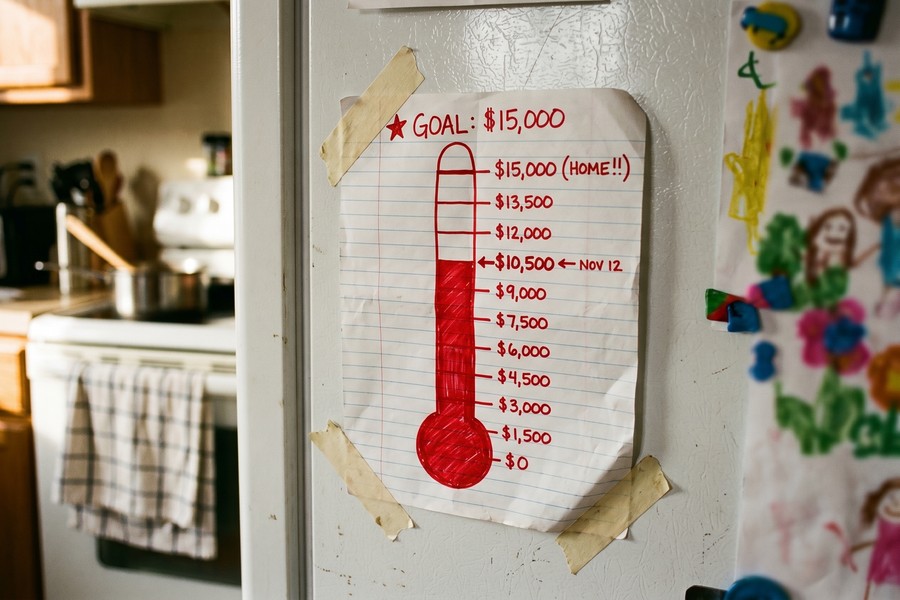
A hand-drawn debt thermometer on the refrigerator tracked total debt remaining in $500 increments. This is not a financial tool — it’s a behavioral one. Research from the field of behavioral economics consistently shows that visual progress tracking increases goal persistence. Seeing the thermometer drop from $22,000 toward $0 provided a tangible, daily reminder of progress that no spreadsheet could replicate.
“Financial behavior change is less about knowing what to do and more about designing your environment so that the right choice is automatic. Discipline is a finite resource — systems are not.”
Common Pitfalls That Derail Low-Income Debt Payoffs
Understanding what went right in this story is only half the picture. Knowing what nearly went wrong — and what derails most people trying to pay off debt low income — is equally important. Several near-misses occurred over the 34 months that could have set the plan back by months or permanently.
Lifestyle Creep After Early Wins
After the retail credit card was paid off in month 7, the temptation to “reward” the progress with a dinner out, a new clothing purchase, or a streaming subscription reactivation was real and immediate. This is called lifestyle creep — the unconscious tendency to expand spending when financial pressure temporarily eases. Every dollar redirected to lifestyle instead of debt extends the payoff timeline and increases total interest paid.
The rule implemented: no lifestyle changes until $10,000 of the original $22,000 was eliminated. At that halfway mark, a modest celebration ($40 dinner out) was pre-planned and budgeted. Delayed gratification with a defined endpoint is far more sustainable than indefinite deprivation.
The Balance Transfer Trap
Around month 14, a 0% balance transfer offer arrived for the major bank credit card balance. It looked like a free shortcut — transfer $5,800 to a 0% card, save $600 in interest over 12 months. But the offer required a 3% transfer fee ($174), and the promotional period was only 12 months. If the balance wasn’t paid off in time, the rate would jump to 24.99% retroactively on the remaining balance.
Balance transfer offers can be powerful tools — but only if you can realistically pay off the transferred balance before the promotional period ends. At a $380/month extra payment rate, $5,800 takes 15 months — longer than most 0% promotional periods. Missing the deadline can negate all interest savings and then some.
The offer was declined. The risk of a retroactive rate spike on $2,000+ of remaining balance was not worth the potential savings. The avalanche method proceeded as planned.
Ignoring Tax Credits and Benefits
A critical discovery at tax filing time: the Earned Income Tax Credit (EITC) added $2,847 to the year-one tax refund. This was not anticipated in the original plan. The full refund was applied to the personal loan principal — the highest-balance account — shaving 4 months off the payoff timeline in a single payment.
Many low-income single parents don’t claim every benefit available to them. The Child and Dependent Care Credit, Child Tax Credit, and EITC together can add $3,000-$8,000 annually for a single parent with one child. The IRS Free File program provides free tax preparation for incomes under $73,000. Every dollar of tax savings is a dollar available for debt reduction.
Real-World Example: Maria’s 34-Month Debt Elimination Story
Maria, a 34-year-old medical billing specialist and mother of one daughter (age 8) in Columbus, Ohio, began her debt payoff journey in January 2022 with $22,000 across five accounts and a take-home income of $2,917/month. Her minimum payments totaled $545/month, leaving almost nothing for savings or extra debt payments. She had tried twice before to pay off her debt — once with a personal loan consolidation that she then ran the cards back up on, and once with a Dave Ramsey-style cash envelope system she abandoned after 60 days.
The third attempt was different. Maria spent her first two weeks not paying any extra debt — but instead doing a full budget audit and debt inventory. She negotiated her hospital bill from $4,200 to $2,100, reducing that minimum payment by $47/month. She called her largest credit card issuer and received a temporary hardship rate reduction from 22.49% to 9.99% for 12 months. She canceled four streaming subscriptions and switched from name-brand to store-brand groceries, finding $210/month in cuts that felt minor but added up to $2,520 in Year 1 alone.
By month 10, the retail credit card ($3,400 at 28.99%) was paid in full. By month 16, the store card ($1,100 at 26.99%) was gone. The major bank card — the one with the temporary rate reduction — was eliminated by month 23, before the hardship rate expired and reverted to 22.49%. The personal loan followed by month 30. The negotiated medical bill, now just $2,100, was paid off in month 34. Total interest paid over the entire period: $6,200 — compared to the $14,300 she would have paid making minimums only, and the $22,000+ she might have paid if the balances had been ignored entirely.
In November 2024, Maria financed a used vehicle at a 4.9% interest rate — the best rate her dealer had offered anyone that week. Eighteen months earlier, a car lot had quoted her 14.2% on a similar loan. The difference over a 5-year loan on $18,000 is approximately $6,800. The discipline she built paying off $22,000 in debt will compound in her favor for years through better borrowing rates, a stronger financial foundation, and a daughter who watched her mother eliminate debt deliberately, methodically, and without giving up.
Your Action Plan
-
Complete a full debt inventory
List every debt you owe with the exact balance, interest rate, minimum payment, and creditor contact number. Do this before touching your budget. You cannot strategically attack debt you haven’t fully mapped. Use a spreadsheet or even a paper list — the format doesn’t matter, completeness does.
-
Run a 90-day budget audit
Pull three months of actual bank and credit card statements. Categorize every expense. Most people discover 10-15% of their monthly spending is going to things they barely remember or no longer value — subscriptions, convenience fees, small recurring charges. Redirect every recoverable dollar to debt.
-
Call your highest-interest creditor and ask for a rate reduction
This one phone call can save hundreds or thousands of dollars over a payoff timeline. Ask specifically: “Do you offer hardship programs or temporary interest rate reductions for customers in financial difficulty?” If they say no, hang up and call again — different agents have different discretion. Document the date, time, and rep name for every call.
-
Negotiate any medical debt before paying other unsecured debt
Call the hospital’s billing department and ask for the financial assistance application. Bring documentation of your income and household size. Many hospitals will reduce balances by 40-80% for income-qualifying households. Do this before any balance is sent to collections.
-
Save $1,000 in an emergency fund before extra debt payments begin
Target 8-10 weeks to build this buffer. Park it in a high-yield savings account (currently 4-5% APY at most online banks) so it earns something while it sits. This fund exists solely to prevent credit card charges during emergencies — not for planned expenses or wants.
-
Choose your payoff method and sequence, then automate minimums on all accounts
If you’re motivated by math, use the avalanche (highest rate first). If you’ve quit before, use the snowball (smallest balance first). Automate every minimum payment two days after your payday — this protects your payment history and credit score without requiring monthly willpower. Apply all extra money manually to the target debt mid-month so it feels intentional.
-
Add modest side income and direct 100% of it to debt
Even $100-$200/month in additional income applied entirely to your target debt can cut your payoff timeline by months. Focus on asynchronous work (data entry, online selling, survey panels) that fits around your existing schedule. Don’t count on side income in your base budget — treat it as bonus fuel for the debt fire.
-
Review and claim all available tax credits at filing time
For a single parent with one child and an income under $53,000, the Earned Income Tax Credit alone can provide $2,500-$3,995 at tax time. Add the Child Tax Credit and Child and Dependent Care Credit, and your refund may be significantly larger than expected. Apply the full refund to your highest-balance debt as a lump-sum payment.
Frequently Asked Questions
Is it really possible to pay off debt low income without a second job?
Yes — though it takes longer and requires more intentional budgeting. The case study above involved modest supplemental income averaging $280/month, but the core budget audit and creditor negotiations alone freed up enough to make meaningful progress. A strict budget, creditor negotiations, and tax credits can collectively add hundreds of dollars per month without any additional employment.
The timeline will likely be longer than it would be at a higher income. That’s the honest tradeoff. But “slower” is not the same as “impossible.” Staying in debt indefinitely is always more expensive than a 2-3 year payoff plan — even a slow one.
Should I prioritize debt payoff or saving for retirement?
If your employer offers a 401(k) match, contribute at least enough to capture the full match before directing extra money to debt — that match is a 50-100% instant return on investment, which no debt interest rate can beat. Beyond the employer match, prioritize high-interest debt (above 8-10% APR) over additional retirement contributions until the debt is eliminated.
What if I can’t even afford the minimum payments?
Contact each creditor immediately and ask about hardship programs, deferment options, or reduced payment plans. For federal student loans, income-driven repayment plans cap payments at a percentage of your discretionary income. Our guide on income-driven repayment plans covers how these programs actually work. For credit card debt, nonprofit credit counseling agencies like the National Foundation for Credit Counseling (NFCC) can negotiate reduced rates on your behalf — often at no cost.
How do I handle a debt that’s already in collections?
First, request debt validation in writing within 30 days of the first collector contact — this is your legal right under the Fair Debt Collection Practices Act. Then, negotiate a pay-for-delete or settlement agreement directly with the collection agency, often for 40-60 cents on the dollar. Get any agreement in writing before sending payment. Never pay a collection debt without written confirmation of the terms.
Will closing paid-off credit cards hurt my credit score?
It can — and often does. Closing a credit card reduces your total available credit, which increases your credit utilization ratio. It may also reduce the average age of your accounts if the card is old. Generally, it’s better to keep paid-off cards open with a zero balance or a very small recurring charge (like a Netflix subscription) paid in full monthly. The exception: if having open credit cards is a spending temptation you can’t manage, the score impact may be worth the behavioral benefit of closing them.
How long does it realistically take to pay off $20,000-$25,000 in debt on a moderate income?
With consistent extra payments of $300-$500/month above minimums, $20,000-$25,000 in mixed unsecured debt typically takes 3-5 years. The exact timeline depends heavily on average interest rates, the portion of income available for debt repayment, and whether any lump-sum payments (tax refunds, bonuses) can be applied. Using the avalanche method and applying every extra dollar to debt consistently puts most people in the 2.5-4 year range.
Can I negotiate my credit card interest rate if I have good payment history?
Absolutely — and your chances are better with good payment history. Call the number on the back of your card and ask directly: “I’ve been a customer for X years and have always paid on time. I’ve received competitor offers at lower rates. Can you reduce my interest rate?” Studies show that roughly 70% of people who ask receive at least a partial reduction. The worst they can say is no — and there is no credit score impact for asking.
What’s the best way to handle an unexpected expense during a debt payoff plan?
This is exactly what the starter emergency fund is for. Draw from the fund, pay the expense in cash, then rebuild the $1,000 buffer before resuming extra debt payments. Do not pause the automated minimum payments — only the extra avalanche/snowball payment. Rebuilding the buffer should take priority over extra debt payments for one or two months, then resume the original plan.
Are debt consolidation loans a good idea for low-income borrowers?
Debt consolidation loans can simplify payments and reduce interest — but they require good enough credit to qualify for a rate lower than your existing debts. If your credit score is below 650, the rates on a personal consolidation loan may not be meaningfully better than your current rates. More importantly, consolidation without a behavior change tends to result in new credit card balances being run up on the cleared accounts. The math only works if the root spending patterns have changed. For more on how lenders evaluate your application, see our article on what lenders actually see when they run your loan application.
Does the Earned Income Tax Credit really make a significant difference?
For single parents, yes — significantly. For tax year 2023, a single parent with one qualifying child and income under $46,560 can receive up to $3,995 in EITC. Add the Child Tax Credit (up to $2,000 per child) and the Child and Dependent Care Credit (up to 35% of $3,000 in childcare costs), and the total potential tax benefit exceeds $6,000 annually. Applied as a lump sum to debt, this kind of one-time payment can eliminate an entire account in a single year.
Sources
- Federal Reserve — Consumer Credit (G.19) Statistical Release
- Federal Reserve — Report on the Economic Well-Being of U.S. Households, 2022
- U.S. Census Bureau — Single-Parent Families Data
- Consumer Financial Protection Bureau — How Collection Accounts Affect Credit Scores
- IRS — Earned Income Tax Credit Overview
- IRS — Free File: Do Your Federal Taxes for Free
- National Foundation for Credit Counseling — Consumer Credit Counseling Services
- Federal Trade Commission — Fair Debt Collection Practices Act (Full Text)
- Kaiser Family Foundation — Hospitals, Charity Care, and Community Benefits
- Consumer Financial Protection Bureau — Debt Collection Consumer Tools
- IRS — Child Tax Credit Information
- myFICO — What’s in Your FICO Credit Score
- eLending Services — Should You Pay Off Debt or Build an Emergency Fund First?
- eLending Services — Cash Envelope System vs. Zero-Based Budgeting
- eLending Services — Income-Driven Repayment Plans: A Deep Dive