
Quick Answer
A private party auto loan gives you more control over price negotiation and vehicle choice, but dealership loans offer speed and convenience. As of July 2025, private party loan rates average 7–14% APR depending on credit score, while dealer financing can add 1–3 percentage points in markup. Your best outcome depends on credit strength and how much negotiating leverage you want.
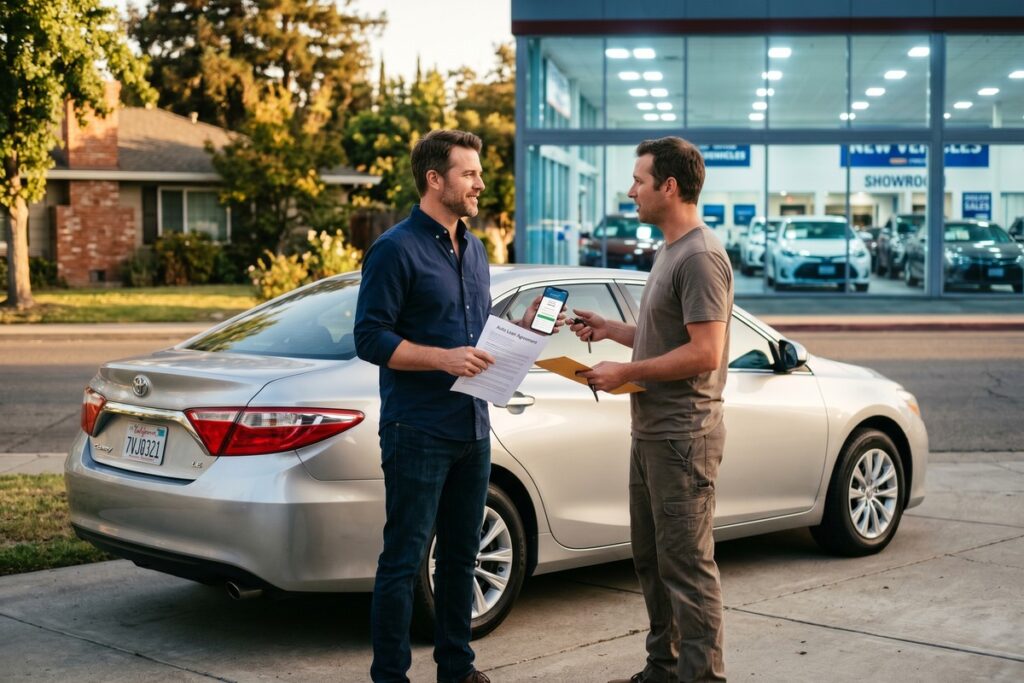
A private party auto loan is a loan used to purchase a vehicle directly from an individual seller rather than a licensed dealership. According to the Consumer Financial Protection Bureau’s auto loan resource center, private party transactions typically result in lower purchase prices because sellers avoid dealer overhead costs — savings that can reach $2,000–$5,000 on comparable vehicles. The tradeoff is a more complex financing process that requires upfront preparation.
With used vehicle prices remaining elevated and interest rates still high in mid-2025, the financing path you choose can add or subtract thousands from your total cost of ownership.
What Exactly Is a Private Party Auto Loan?
A private party auto loan is a secured installment loan issued by a bank, credit union, or online lender specifically to fund the purchase of a vehicle from a private seller. Unlike dealership financing, there is no middleman lender arrangement — you apply independently, get approved, then bring the funds to the transaction.
Lenders that offer this product include major institutions like Chase Auto, LightStream (a division of Truist Bank), and federal credit unions operating under NCUA oversight. The loan is secured by the vehicle title, meaning the lender holds a lien until the loan is paid off. The buyer typically receives a check or draft made out to the seller at closing.
How the Funding Process Works
Most lenders require a vehicle inspection or a VIN verification before disbursing funds. You will also need to provide the seller’s name, the vehicle’s year, make, model, mileage, and a bill of sale. Once approved, the lender sends payment directly — either to the seller or as a cashier’s check you deliver in person.
Before applying, it helps to understand how pre-approval differs from final approval. Our guide on auto loan pre-approval vs. pre-qualification clarifies what each step actually secures for you as a borrower.
Key Takeaway: A private party auto loan is issued directly by a bank, credit union, or online lender — not the seller. Lenders like LightStream require VIN verification and a bill of sale, and loan amounts typically cap at 100% of the vehicle’s private party value per Kelley Blue Book.
How Do Private Party Loan Rates Compare to Dealership Rates?
Private party auto loan rates are almost always competitive with — and frequently lower than — effective dealer financing rates, because dealers can mark up the rate they receive from their lender partners. The difference is not always visible on a window sticker.
According to Experian’s State of the Automotive Finance Market report, the average interest rate for a used vehicle loan in Q1 2025 was 11.78% for all credit tiers combined. Dealer reserve — the markup a dealership adds above the “buy rate” — can legally add up to 2.5 percentage points in many states, according to guidance from the Federal Trade Commission.
Rate Differences by Credit Tier
Your FICO Score is the primary driver of the rate you qualify for, regardless of lender type. Super-prime borrowers (scores of 781 and above) typically see the smallest gap between private party and dealer rates, because both routes are competing for low-risk business. Subprime borrowers (scores below 601) often find private party lenders more restrictive, with some refusing to finance vehicles over a certain age or mileage.
| Credit Tier (FICO) | Avg. Private Party Rate (2025) | Avg. Dealer Rate (with markup) |
|---|---|---|
| Super Prime (781+) | 6.5% – 7.5% | 6.9% – 8.0% |
| Prime (661–780) | 8.5% – 10.5% | 9.5% – 12.0% |
| Non-Prime (601–660) | 11.0% – 14.0% | 13.0% – 16.5% |
| Subprime (501–600) | 14.0% – 18.0% | 16.0% – 21.0% |
| Deep Subprime (300–500) | Limited availability | 20.0% – 25.0%+ |
Key Takeaway: Dealer financing markups can legally reach 2.5 percentage points above the lender’s buy rate, according to FTC guidance. On a $20,000 loan over 60 months, that markup adds roughly $1,500 or more in total interest — money that stays in the dealership’s pocket, not yours.
What Control Does Each Financing Path Actually Give You?
Private party auto loans give borrowers significantly more control at the negotiating table, while dealership loans prioritize convenience over transparency. Understanding where control actually lives changes how you approach either transaction.
With a private party purchase, you negotiate the purchase price before financing enters the picture. The seller has no financial incentive to steer you toward a particular lender or loan term. You bring pre-approved financing, name your price, and close without financing pressure. Dealership financing bundles the purchase price, trade-in value, and loan terms into one negotiation — a structure that the FTC has specifically flagged as a source of consumer confusion and overpayment.
“When consumers allow dealers to control both the vehicle price and the financing terms simultaneously, they lose the ability to evaluate either one clearly. Separating the negotiations — or bypassing the dealer entirely — is one of the most effective cost-control strategies available.”
Dealership loans do offer real advantages: same-day approval, manufacturer incentive rates (sometimes as low as 0% APR on new vehicles), and the convenience of completing the entire transaction in one location. However, those incentive rates apply almost exclusively to new cars — not used private party vehicles.
If you have previously made mistakes navigating dealership financing, the detailed breakdown in 5 Mistakes People Make When Financing a Car at the Dealership is worth reviewing before your next purchase.
Key Takeaway: Separating price negotiation from financing — as a private party auto loan forces you to do — removes the dealer’s ability to obscure markups. The FTC estimates that bundled F&I negotiations cost buyers an average of hundreds to thousands of dollars in unnecessary costs per transaction.
What Are the Risks of a Private Party Auto Loan?
Private party auto loans carry specific risks that dealership purchases largely eliminate through certification programs and consumer protection regulations. Knowing these risks in advance prevents costly surprises.
The biggest risk is vehicle condition. Dealerships selling certified pre-owned vehicles must meet manufacturer inspection standards — private sellers have no such obligation. A vehicle history report from Carfax or AutoCheck is essential, and an independent mechanical inspection ($100–$200) is strongly recommended before signing anything.
Title and Lien Complications
Private sellers may have an existing lien on the vehicle they are selling. If the seller still owes money to their lender, the title cannot transfer cleanly until that lien is satisfied. Some lenders handle this during disbursement by paying off the seller’s existing loan directly, but you must confirm this process before closing. Your state’s DMV handles title transfer, and failure to complete it correctly within the required window (often 10–30 days) results in penalties.
Loan term length also affects your total risk exposure. Our analysis of short-term vs. long-term auto loan math shows how extending a private party loan from 48 to 72 months can increase total interest paid by more than 40%.
Key Takeaway: Private party purchases require buyers to independently verify title status, lien payoffs, and vehicle condition. Skipping a pre-purchase inspection — which costs as little as $100 — is one of the most common ways buyers overpay on used vehicle purchases, both in purchase price and post-sale repair costs.
When Should You Choose a Private Party Loan vs. Dealership Financing?
Choose a private party auto loan when you want maximum price control, have strong credit, and are comfortable managing the logistics of an independent transaction. Choose dealership financing when speed matters, when manufacturer incentive rates are available, or when your credit profile limits your independent lender options.
Borrowers with FICO scores above 720 typically qualify for the most competitive private party rates and have the most to gain from bypassing dealer markup. Borrowers with scores below 600 may find that dealer-affiliated subprime lenders are their primary accessible option, though they should carefully review total loan cost before signing.
If you are building credit for the first time and need an auto loan, the strategies outlined in how to get your first auto loan with no credit history apply equally whether you are buying from a private seller or a dealer. Additionally, if you are currently overpaying on an existing loan, paying off your auto loan early vs. investing the difference is a decision worth calculating before your next vehicle purchase.
Key Takeaway: A private party auto loan is the stronger choice for credit-qualified buyers — those with FICO scores of 720 or above can realistically save $1,000–$3,000 in total interest compared to dealer financing on an equivalent used vehicle loan, based on Experian’s 2025 rate data.
Frequently Asked Questions
What credit score do I need to get a private party auto loan?
Most lenders offering private party auto loans require a minimum FICO score of 600–640, though the best rates go to borrowers at 720 and above. Some credit unions have more flexible underwriting standards for members, making them a strong starting point if your score is in the 580–620 range.
Can I get a private party auto loan from a credit union?
Yes, and credit unions are often the best source. Federal credit unions regulated by the NCUA typically offer lower rates than banks or online lenders for private party transactions. Membership is required, but many credit unions have broad eligibility — including community membership or employer affiliation.
How long does it take to get approved for a private party auto loan?
Online lenders like LightStream can issue same-day approval decisions. Bank and credit union approvals typically take 1–3 business days. Pre-approval before you find a vehicle is recommended — it gives you a firm budget and strengthens your position as a buyer when negotiating with a private seller.
Do private party auto loans have higher interest rates than dealer loans?
Not inherently. Private party loan rates are set by the lender based on your credit profile. Dealer loans can appear lower but often include a markup above the lender’s actual rate. For borrowers with strong credit, private party rates from banks and credit unions are frequently more competitive than effective dealer rates after markup is factored in.
Can I use a private party auto loan to buy a car from a family member?
Some lenders allow it, but many restrict private party loans to arm’s-length transactions between unrelated parties. Check with the specific lender before applying. If the lender prohibits family transactions, a personal loan may serve as an alternative, though rates are typically higher.
What happens if the private seller still owes money on the car?
The seller’s existing lien must be satisfied before the title can transfer to you. Some lenders will pay off the seller’s loan directly from your loan proceeds. You must confirm this process with both your lender and the seller’s lienholder before the transaction closes — otherwise, you could take ownership of a car with an encumbered title.
Sources
- Consumer Financial Protection Bureau — Auto Loans Resource Center
- Experian — State of the Automotive Finance Market, Q1 2025
- Federal Trade Commission — Automobile Purchases and Financing Consumer Protection
- National Credit Union Administration — Consumer Protection Resources
- Kelley Blue Book — Private Party Vehicle Value Guide
- Edmunds — How Dealers Make Money on Financing
- LightStream — Private Party Auto Loan Details and Requirements